No mains, no network, and it runs for a season on AA cells · review
GardePro E8 review
GardePro pairs by Bluetooth before switching to Wi-Fi, which removes the step where trail-camera apps usually fail. It states 64 MP stills, 1296p H.264 video, 36 no-glow LEDs and an external high-gain antenna, with no subscription.
The conclusion The only trail camera here that pairs over Bluetooth before switching to Wi-Fi. The lowest video resolution in the hub, and an app that is easier to connect.
Most trail cameras with an app have the same story: it worked in the kitchen,
it failed in the field, and the owner went back to carrying a card reader.
GardePro’s answer is to pair over Bluetooth first and then hand the connection
to Wi-Fi.
Why that is the whole product
Joining a camera’s own Wi-Fi by hand means going into phone settings, finding
an unfamiliar network, ignoring the warning that it has no internet, and
stopping the phone from hopping back to mobile data. In a field, in the cold,
this is where people give up. Bluetooth removes every one of those steps.
The external high-gain antenna then means the transfer works up to 15 m (49 ft) away
in open ground, per GardePro, rather than with the phone held against the housing.
What it trades
Video is 1296p in H.264, the lowest here: the other cameras in this hub state
2K to 5K. The stills are stated at 64 MP with no sensor size published; the
Lutranstra D909 and Mucxtaim H3W here reach the same figure from a 5 MP sensor. If you crop into
video afterwards, this is the wrong camera; if you look at photographs, it is
not.
No monthly fee
GardePro states the app costs nothing to use. That is worth checking on any
camera in this family: several manufacturers have moved image transfer behind
a subscription, and a trail camera with a recurring fee is a different
proposition entirely.
Who it suits
Anybody who has abandoned a trail-camera app before and would rather not
again.
Availability
Listed but with no offer on the American Amazon store — the reference exists there and nobody is currently selling it.
Prices and availability are what Keepa reported on the date this page was updated; both move.
What reassures, and what does not
Strengths
Bluetooth pairing before Wi-Fi — the step that defeats most trail-camera apps
External high-gain antenna, local link stated up to 15 m (49 ft) in open ground
36 × 940 nm no-glow LEDs
App stated to have no monthly fee
Compromises
1296p video rather than 4K
Still a local connection — nothing reaches you at home
Card and batteries not supplied
H.264 rather than the more efficient H.265
Specifications
Stills
Up to 64 MP, stated by GardePro
Video
1296p, H.264, with sound
Pairing
Bluetooth, then local Wi-Fi — no home router or mobile network needed
Antenna
External high-gain
Night illumination
36 LEDs at 940 nm, no-glow
Trigger speed
0.1 s, three PIR sensors, stated by GardePro
Weather rating
IP66
Power
8 AA batteries (not supplied) or external supply
App
No monthly fee, stated by the manufacturer
Amazon reference
B097H6B788
EAN
0196852201006
The questions we are asked
Why does Bluetooth pairing matter?
Because joining a camera's Wi-Fi network by hand, in a field, on a phone that keeps hopping back to mobile data, is where most people abandon a trail-camera app. Bluetooth hands the connection over directly. It is a small engineering decision that decides whether the feature gets used at all.
Is 1296p enough?
For video, generally yes — trail-camera video is used to see what happened, and the stills are where the detail is. If you plan to crop heavily into video afterwards, the 4K models here are the better choice.
What does the external antenna change?
Range on the local link, stated up to 15 m (49 ft) in open ground. It means transferring from a distance rather than with the phone pressed against the housing, which matters when the camera is up a tree or behind a fence.
Our score
7.8/ 10
The only trail camera here that pairs over Bluetooth before switching to Wi-Fi. The lowest video resolution in the hub, and an app that is easier to connect.
What this one costs among trail cameras
A reference exists on these Amazon stores: France, Germany, Italy, Spain, United Kingdom, United States. Listed is not the same as in stock — availability changes daily.
Details checked on September 2, 2026.
The buyer this one serves, among security devices
Anyone who has already given up on a trail camera app once.
Sources
Specifications: the manufacturer sheet for home security products and the matching Amazon product page. Prices and availability: Keepa. Every figure on this page names its source.
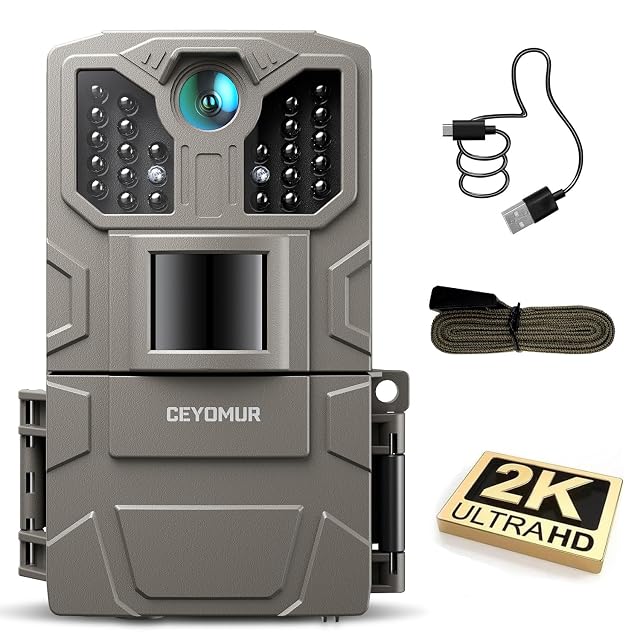
2K video · 24 × 850 nm IR LEDs · IP66 · camouflage housing · keyhole lock point
A camouflaged trail camera with 24 infrared LEDs at 850 nm and a front-opening body. CEYOMUR states 2K video with audio, an IP66 housing and a built-in keyhole for a lock.
Best for: A shed, a gate on a track or a plot with no power, where the camera should not be obvious.
4K · 32MP · 940 nm no-glow to 24 m (79 ft) · 0.1–0.3 s trigger · −29 to 21 °C (-20 to 70 °F) rated · IP66
HSSNS states 4K video, 940 nm no-glow night vision to 24 meters (79 ft), a trigger of 0.1 to 0.3 seconds with three-shot bursts, and operation rated from −29 °C (−20 °F) to 21 °C (70 °F), with a 2.4-inch color screen and password protection.
Best for: A cold, exposed position where the camera has to keep working through a winter.
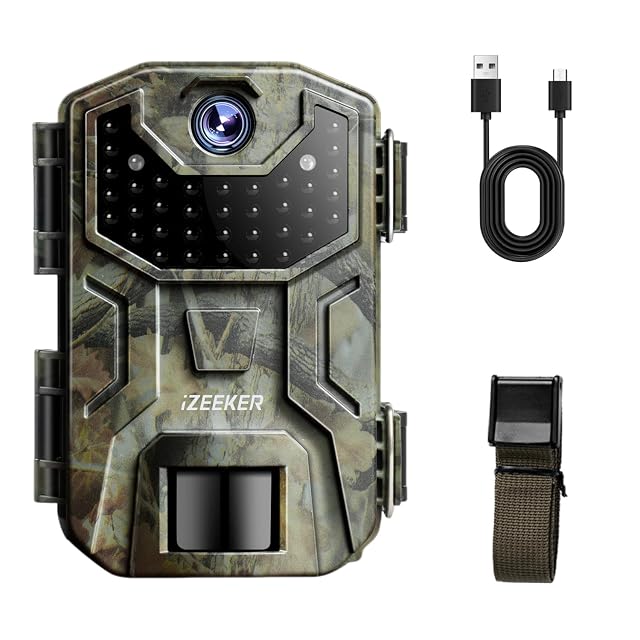
2K · 36MP stills · 940 nm no-glow · 0.2 s trigger · clamshell body · illuminated keypad
iZEEKER publishes the figure that matters — a 0.2 second trigger — alongside 940 nm no-glow infrared, 2K video, three-shot bursts and a clamshell body with a bottom-opening battery compartment.
Best for: Watching a gate or a track discreetly, where nobody should be able to see the camera working at night.