Skip to content

The best PoE camera systems for 2026

A wired kit is the answer when a battery camera has already been the problem. One Ethernet cable carries both power and video, so there is no charging, no Wi-Fi contention, and the recorder keeps working when the internet does not — which is the difference that matters during a power cut with a mobile router down. The costs are real: cable runs through walls, and a recorder that needs a home. We compare channel count and expansion, included drive size, camera resolution, cable lengths supplied and offline operation. How many days a kit holds is not a figure any maker here publishes — it depends on your own resolution, frame rate and mode, and your recorder estimates it better than we could.

The models we recommend

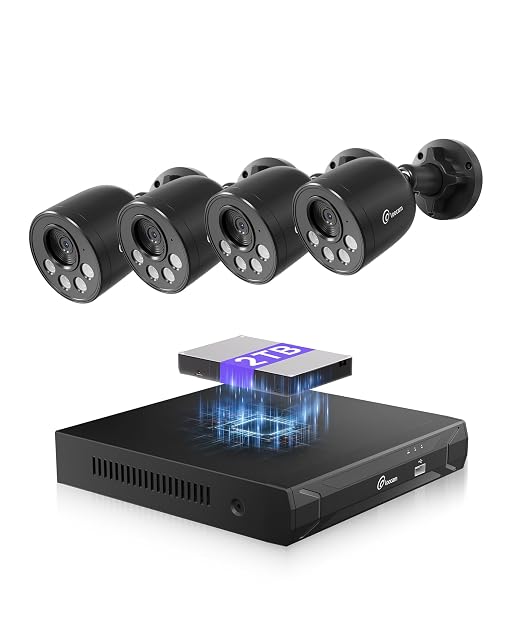
  1. Loocam LC8P8B-8B42E-180

    4K 8MP · 8-channel NVR · 2 TB drive included · H.265+ · 30 m (98 ft) IR

    An eight-channel 4K kit with the recorder and the drive in the box. Loocam states 8 MP cameras, H.265+ compression and a 2 TB drive already fitted, with person detection and push alerts.

    Best for: A first wired system, where everything arriving in one box matters more than the last word in image processing.
    7.2/10

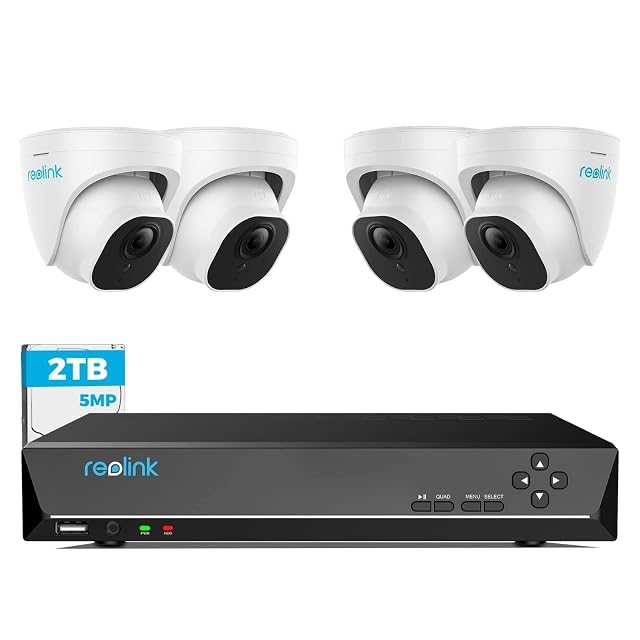
  2. Reolink RLK8-520D4 (5 MP dome set)

    4× 5MP domes · 8CH NVR with 2 TB · 18 m (59 ft) cables supplied · 24/7 recording

    Four 5 MP dome cameras, an eight-channel recorder with a 2 TB drive, and 18-meter network cables in the box. Reolink states person and vehicle detection, continuous recording and compatibility with its 4, 5 and 8 MP cameras.

    Best for: A house wanting a system that will still be supported and expandable in five years.

    7.8/10

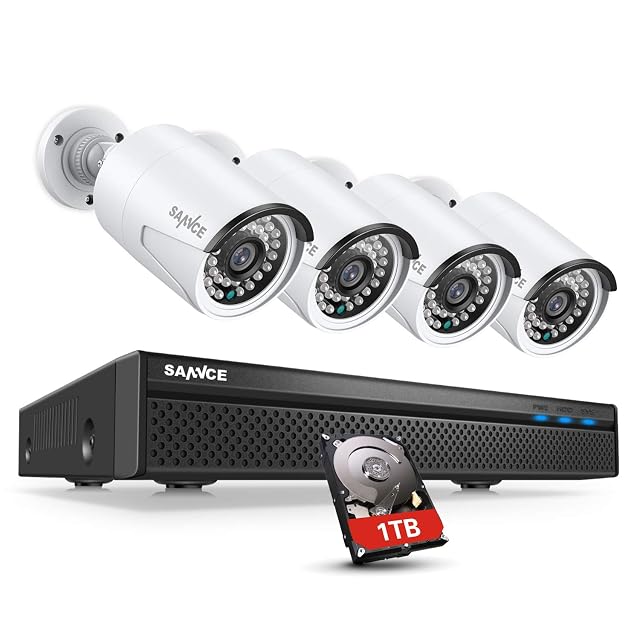
  3. SANNCE SE-N48PBE1-64BE-P

    3MP cameras · 5MP-capable 8CH NVR · 1 TB drive · H.264+ · IP66 metal housings

    A lower-resolution kit built around metal camera housings and an 8-channel recorder that accepts up to 5 MP. SANNCE states 3 MP cameras, H.264+ compression and a 1 TB drive, expandable to eight cameras.

    Best for: An installation where housings that survive a knock matter more than resolution.

    7.8/10

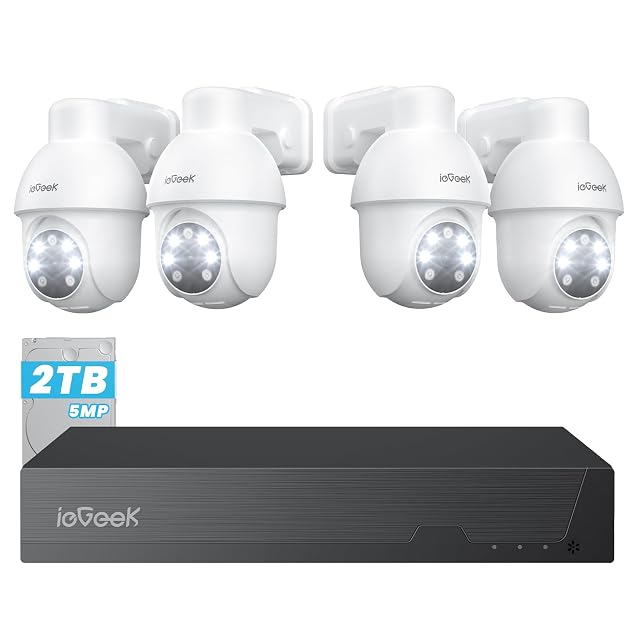
  4. ieGeek IE92

    8MP · four 355° × 90° PT cameras · 15 m (49 ft) color night vision · auto-tracking · 8CH NVR

    The only wired kit here whose cameras pan and tilt. ieGeek states 8 MP at 3840 × 2144, color night vision to 15 m (49 ft), AI detection with auto-tracking, and two-way audio, on an eight-channel PoE recorder.

    Best for: A property with several approaches, where four fixed cameras would leave gaps that four moving ones do not.

    7.8/10

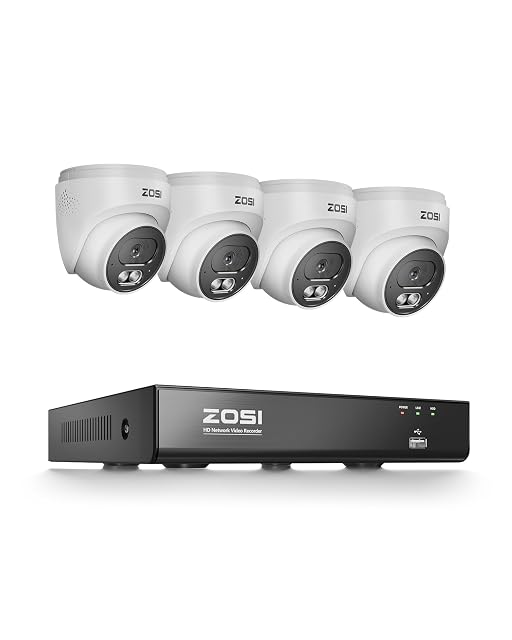
  5. ZOSI C220

    4K 8MP × 4 · 20 fps · AI person and vehicle · two-way audio · IP66

    Four 8 MP cameras at 20 frames per second with AI person and vehicle classification and two-way audio at each camera, in IP66 housings. ZOSI states 30 m (98 ft) night vision and plug-and-play PoE wiring.

    Best for: A wired system where you want to speak to a delivery driver from the camera rather than only watch them.

    7.8/10

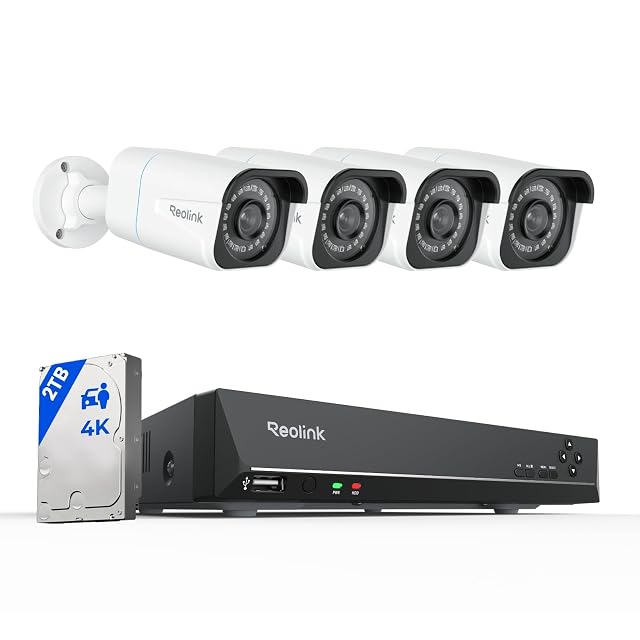
  6. Reolink RLK8-800B4

    4× 4K bullets · 8CH NVR with 2 TB · person and vehicle detection · 24/7

    The 4K version of Reolink's wired kit: four 8 MP bullet cameras at 20 fps, an eight-channel recorder with a 2 TB drive pre-installed, and detection that filters branches and insects out of the alerts.

    Best for: A property where footage may have to be handed to somebody else, and detail decides whether it is any use.

    8.4/10

The need before the model, across poE camera systems

Consistent image quality

The resolution of a system's cameras decides how usable the whole recording is. It is a choice that commits you for years.

ieGeek IE92

Seeing at night

Night vision range decides what you can make out after sunset, when surveillance is of most use.

Reolink RLK8-520D4 (5 MP dome set)

Powering every camera at once

A recorder whose total budget is below the sum of the cameras leaves one dead without saying so. The stated total power is compared with the sum of consumptions, not with the number of ports.

Reolink RLK8-800B4

Who buys what, across poE camera systems

A cable pulled once for ten years
A wired system depends on neither Wi-Fi nor batteries. It is the most reliable solution for continuous surveillance.
Continuous recording
A dedicated recorder records permanently, which no battery camera does. The timeline is complete.
Light installation
Running network cable through an existing building is the real work. That is what discourages people most often.

Nothing is free: the trade-offs of poE camera systems

Reliability against cabling work
A single cable carries data and power, which is very reliable. Running it through an existing building is a project in itself.
Continuous recording against disk capacity
Recording permanently in high definition fills a disk very fast. The retention period is calculated before buying.
Closed system against expandable
An all-in-one kit installs simply and locks you into an ecosystem; an open system accepts cameras from different makers.

Buyers’ questions on poE camera systems

What does power over the network cable bring?

One cable per camera for both data and power. That is what makes the installation tidy and reliable, with no socket needed nearby.

What cable length is possible?

The network standard limits the distance per segment. Beyond that, an intermediate switch is needed.

How much recording time is kept?

It depends on the number of cameras, the definition and the disk capacity. The calculation is done before buying, not after.

Does the system work without internet?

Yes: recording is local. Only remote viewing needs a connection.

Do I need a specific disk?

Drives designed for surveillance stand up to continuous writing, unlike a desktop drive. It is a real service-life criterion.

Can makes be mixed?

Open systems accept cameras conforming to a common protocol. Closed kits accept only their own cameras.

Does the installation have to be declared?

For a private individual filming only their own property, no. An installation filming a place open to the public falls under a different regime.

How many days of recording from a given drive?

The sum depends on the number of cameras, the bitrate of each stream and the recording mode, not on capacity alone. Recording on detection keeps several weeks where continuous keeps a few days.

What to take away from poE camera systems

A single cable carries data and power: it is the most reliable solution, and running it is the real work. Calculate the retention period before buying, and a desktop drive does not stand up to the continuous writing of a recorder.

The gist of poE camera systems, at a glance

  • Storage: 1 to 2 TB hard drive, on 3 of the 6 models.
  • Highest figure for night vision: ZOSI C220 (Infrared, stated to 30 m (98 ft)).

A comparison of poE camera systems

A characteristic has to come from four devices in five to hold a column. Below that, we would be lining up empty cells.

ModelPriceNight vision
ieGeek IE92—Color, stated to 15 m (49 ft)
Loocam LC8P8B-8B42E-180—Infrared, stated to 30 m (98 ft)
Reolink RLK8-520D4 (5 MP dome set)—Infrared, stated to 30 m (98 ft)
Reolink RLK8-800B4——
SANNCE SE-N48PBE1-64BE-P—Infrared up to 30 m (98 ft), stated by SANNCE
ZOSI C220—Infrared, stated to 30 m (98 ft)

The guides devoted to poE camera systems

Sources, and how we judge

Specifications: manufacturer sheets for home security products and the matching Amazon product pages. Prices and availability: Keepa. Every figure in this table names its source.

Most recent revision in this category: September 2, 2026.

What we look at on poE camera systems