Skip to content

The best trail cameras for 2026

A trail camera watches a place with no power and no network — a shed at the end of a garden, a gate on a track, a plot under construction. Its defining figure is trigger speed: the delay between the sensor detecting warmth and the shutter firing, which decides whether the image shows a subject or an empty frame they have already left. The other choice is the infrared: no-glow emitters are invisible at night, low-glow ones show a faint red; yet in this hub the longest published ranges are no-glow. We compare trigger speed, detection range, infrared type and power, AA cells or solar. No camera in this hub sends over 4G.

The models we recommend

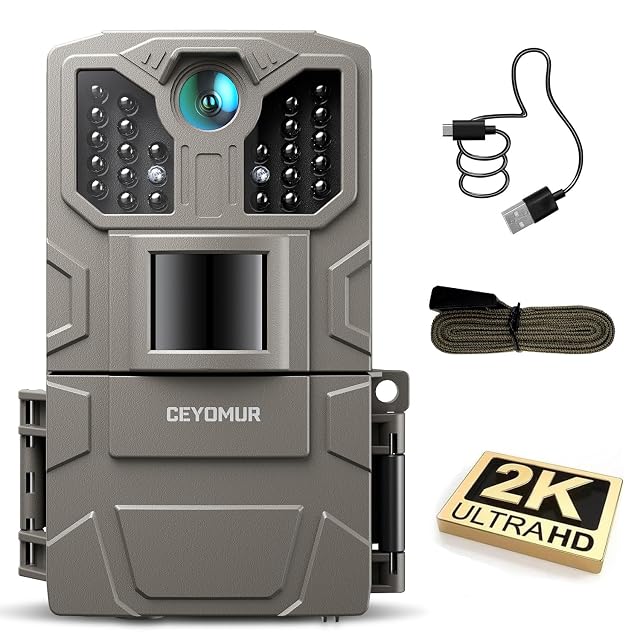
  1. CEYOMUR CY40

    2K video · 24 × 850 nm IR LEDs · IP66 · camouflage housing · keyhole lock point

    A camouflaged trail camera with 24 infrared LEDs at 850 nm and a front-opening body. CEYOMUR states 2K video with audio, an IP66 housing and a built-in keyhole for a lock.

    Best for: A shed, a gate on a track or a plot with no power, where the camera should not be obvious.
    7.2/10

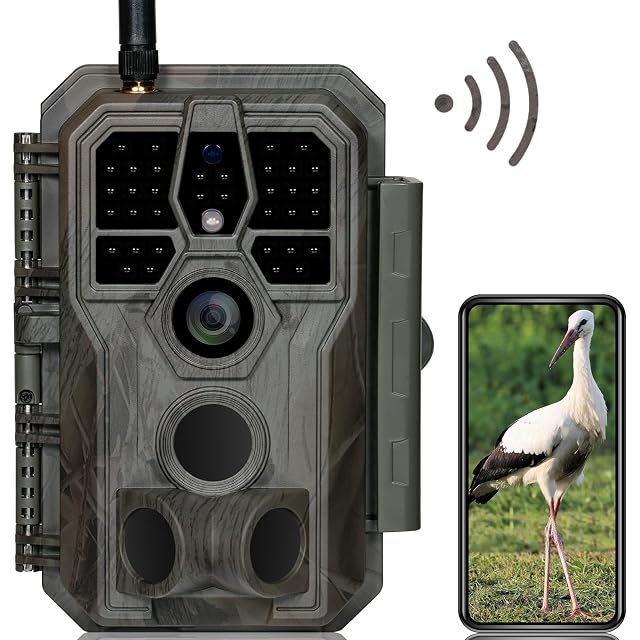
  2. GardePro E8

    64MP stills · 1296p H.264 video · Bluetooth and Wi-Fi pairing · 36 × 940 nm LEDs · no monthly fee

    GardePro pairs by Bluetooth before switching to Wi-Fi, which removes the step where trail-camera apps usually fail. It states 64 MP stills, 1296p H.264 video, 36 no-glow LEDs and an external high-gain antenna, with no subscription.

    Best for: Anyone who has already given up on a trail camera app once.

    7.8/10

  3. HSSNS 4K Trail Camera

    4K · 32MP · 940 nm no-glow to 24 m (79 ft) · 0.1–0.3 s trigger · −29 to 21 °C (-20 to 70 °F) rated · IP66

    HSSNS states 4K video, 940 nm no-glow night vision to 24 meters (79 ft), a trigger of 0.1 to 0.3 seconds with three-shot bursts, and operation rated from −29 °C (−20 °F) to 21 °C (70 °F), with a 2.4-inch color screen and password protection.

    Best for: A cold, exposed position where the camera has to keep working through a winter.

    7.8/10

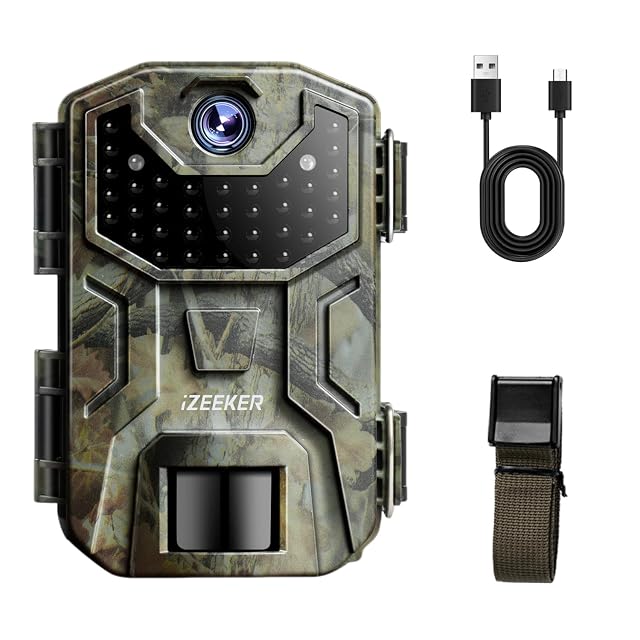
  4. iZEEKER Trail Camera (940 nm)

    2K · 36MP stills · 940 nm no-glow · 0.2 s trigger · clamshell body · illuminated keypad

    iZEEKER publishes the figure that matters — a 0.2 second trigger — alongside 940 nm no-glow infrared, 2K video, three-shot bursts and a clamshell body with a bottom-opening battery compartment.

    Best for: Watching a gate or a track discreetly, where nobody should be able to see the camera working at night.

    7.8/10

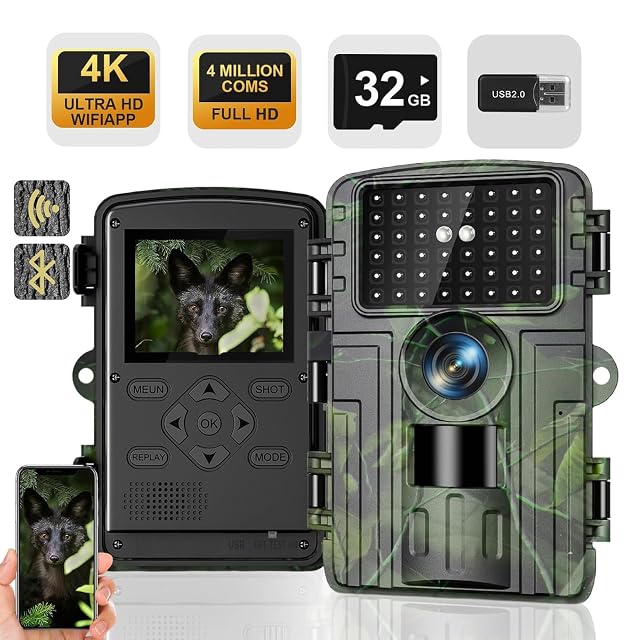
  5. Lutranstra PR5000

    4K video · 60MP · own Wi-Fi hotspot with app · 46 × 940 nm LEDs to 25 m (82 ft) · 32 GB card supplied

    A trail camera that makes its own Wi-Fi so a phone can collect the images without a card reader. Lutranstra states 4K video, 46 infrared LEDs at 940 nm reaching 25 m (82 ft), an IP66 housing and a 32 GB card in the box.

    Best for: A camera you visit but do not want to unclip — the images come off it standing in front of it.

    7.8/10

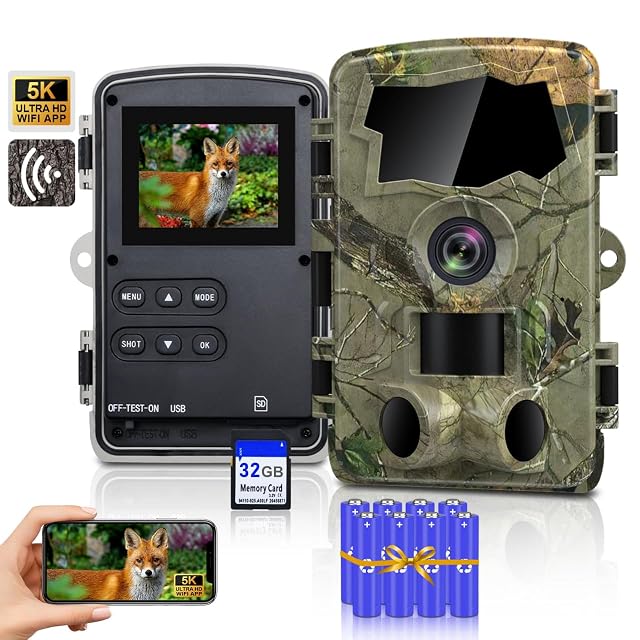
  6. Lutranstra D909

    5K · 64MP · 130° lens · 850 nm IR · app over local Wi-Fi · 32 GB card and 8 AA cells supplied

    The higher-resolution of the two Lutranstras here: 5K video and 64 MP stills behind a 130° lens, with the same local Wi-Fi app transfer, and a box that includes both a 32 GB card and eight AA batteries.

    Best for: A wide scene — a yard, a clearing, a gate with a track either side — where the lens matters more than the reach.

    7.8/10

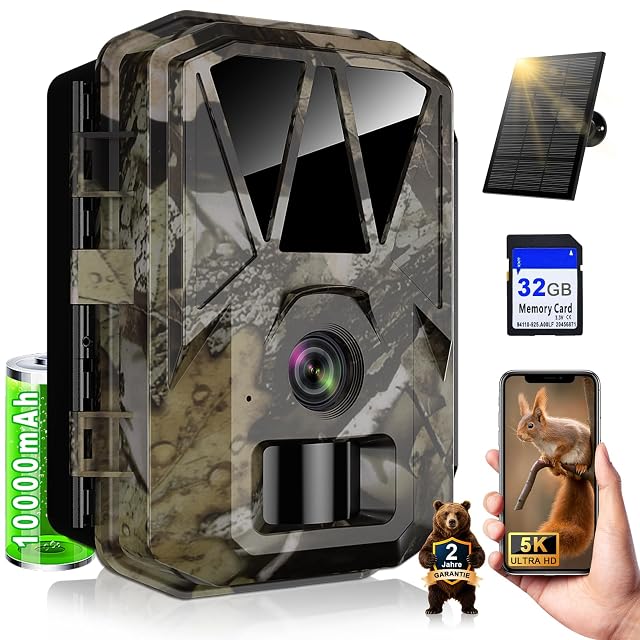
  7. Mucxtaim H3W

    5K · 64MP · solar with 10,000 mAh cell · 120° lens · 850 nm IR · IP66

    A solar trail camera with a built-in 10,000 mAh rechargeable cell, so it does not run on AA batteries at all. Mucxtaim states 5K video, 64 MP stills, a 120° lens and app transfer over its own Wi-Fi or Bluetooth.

    Best for: A position visited rarely, where changing batteries is the thing you want to stop doing.

    8.4/10

The need before the model, across trail cameras

A usable image

Video definition decides what you can make out in a sequence taken at night and at a distance. The highest figures in this section are the Lutranstra D909 and the Mucxtaim H3W at 5K; the GardePro E8 stays at 1296p.

Mucxtaim H3W

Seeing far at night

The range of the night illumination decides at what distance a subject stays visible. The longest stated ranges here: Lutranstra 4K at 25 m (82 ft) and HSSNS at 24 m (79 ft), both with invisible 940 nm light.

Lutranstra PR5000

Triggering fast enough

A one-second trigger delay lets an animal crossing the frame leave nothing but a tail. The Lutranstra D909 states under 0.1 s with two PIR sensors, like the Mucxtaim.

Lutranstra D909

Who buys what, across trail cameras

Wildlife observation
That is the format's original use: observing without a human present, over weeks. Endurance then comes before definition.
Watching an isolated plot
A plot with no electricity or network cannot take any other solution. A trail camera records there without alerting anyone; a solar 4G camera alerts you, for the price of a data plan.
Frequented area
A camera filming a path used by people raises exactly the same legal questions as any video surveillance.

Nothing is free: the trade-offs of trail cameras

Endurance against definition
Filming in high definition consumes far more than a photo. Over several weeks, the setting decides how long the observation lasts.
Visible against invisible illumination
Red-glow LEDs are visible; invisible LEDs are discreet. Discretion is often said to cost range, but in this hub the longest published ranges are invisible 940 nm.
Trigger time against misses
A slow trigger lets a fast subject through. Check the stated delay: the CEYOMUR CY40, the cheapest, does not publish one.

Buyers’ questions on trail cameras

Can it be used to watch a property?

Technically yes, with the same obligations as any video surveillance: filming only your own property and informing the people liable to be filmed.

What is the trigger time?

The delay between detection and capture. If it is long, a fast subject crosses the field without being captured.

Is the night illumination visible?

Red-glow LEDs are visible at night; invisible LEDs are not. In this hub the longest stated ranges (24 and 25 m) are invisible 940 nm.

How many weeks does a trail camera last?

From a few weeks to several months depending on settings and temperature. Videos consume far more than photos.

Do I need lithium batteries?

They hold up markedly better in the cold and keep for a long time. In winter the difference with alkaline cells is very marked.

How do I avoid needless triggers?

Avoid aiming at moving vegetation or an area in direct sun, and adjust the sensitivity. Branches and temperature variations trigger a great deal.

Does the camera stand up to rain?

The models are designed for outdoor use, with varying ratings. A badly closed battery hatch can let water in.

Can it be stolen?

It is a real risk on an isolated plot. Anti-theft housings and security cables exist for that.

What to take away from trail cameras

The trigger time decides whether a fast subject is captured or missed: check the stated delay. Invisible LEDs are discreet, lithium cells hold up far better in the cold — and a badly closed battery hatch lets water in.

The gist of trail cameras, at a glance

  • Lens: 120 to 130 ° wide angle, on 3 of the 7 models.

A comparison of trail cameras

A characteristic has to come from four devices in five to hold a column. Below that, we would be lining up empty cells.

ModelPriceNight illuminationVideoTrigger speedWeather rating
CEYOMUR CY40—24 infrared LEDs at 850 nm2K with audio, stated by CEYOMUR——
GardePro E8—36 LEDs at 940 nm, no-glow1296p, H.264, with sound0.1 s, three PIR sensors, stated by GardeProIP66
HSSNS 4K Trail Camera—940 nm no-glow, stated to 24 m (79 ft)4K, with 32 MP stills, stated by HSSNS0.1 to 0.3 s, with three-shot burstIP66
iZEEKER Trail Camera (940 nm)—940 nm no-glow infrared2K, with 36 MP stills, stated by iZEEKER0.2 s, stated by the manufacturerIP66
Lutranstra PR5000—46 LEDs at 940 nm, stated to 25 m (82 ft)4K, from a 4 MP color CMOS sensor, stated by Lutranstra0.1 to 0.3 s, stated by LutranstraIP66, −30 °C (-22 °F) to 70 °C (158 °F) stated
Lutranstra D909—850 nm infrared, a faint red glow visible up close5K UHD from a 5 MP sensor, 64 MP stills, stated by LutranstraUnder 0.1 s with two PIR sensors, stated by LutranstraIP66, −30 °C (-22 °F) to 70 °C (158 °F) stated
Mucxtaim H3W—850 nm infrared5K UHD from a 5 MP sensor, 64 MP stills, stated by MucxtaimUnder 0.1 s, stated by MucxtaimIP66, −30 °C (-22 °F) to 70 °C (158 °F) stated

The guides devoted to trail cameras

Sources, and how we judge

Specifications: manufacturer sheets for home security products and the matching Amazon product pages. Prices and availability: Keepa. Every figure in this table names its source.

Most recent revision in this category: September 2, 2026.

What we look at on trail cameras