Skip to content

The best memory cards for security cameras in 2026

A security camera writes continuously and overwrites the oldest footage forever, which is the workload ordinary cards are least suited to. High-endurance cards are built for it and state their life in hours of continuous recording rather than in read speed. The number in the listing — the big one, in megabytes per second — describes reading, not the sustained writing a camera does. The other limit is the camera's own: many refuse anything above 128 or 256 GB regardless of what the card can do. All four cards on this page are general-purpose, none high-endurance: we compare capacity, stated write speed and the kind of recording each suits.

What we recommend

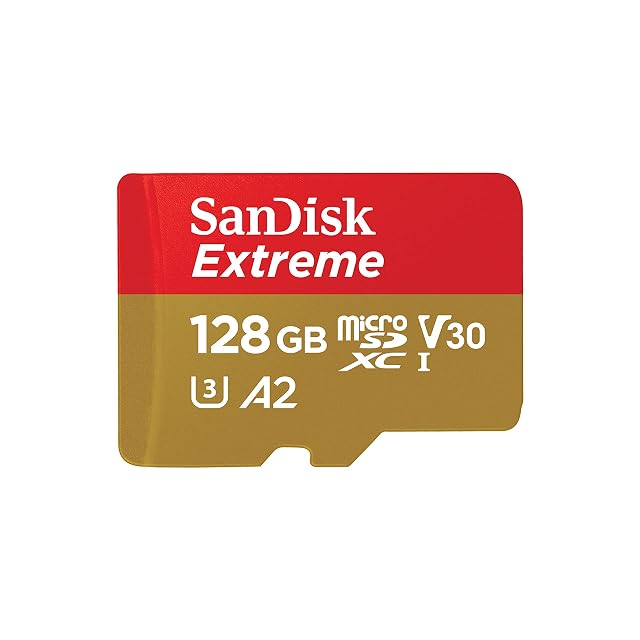
  1. SanDisk Extreme 128 GB microSDXC card with adapter

    SanDisk Extreme microSDXC 128 GB

    A fast, widely available 128 GB card that most cameras accept. It is sold for action cameras rather than for continuous surveillance, and the distinction matters more than the speed figure does.

    Capacity
    128 GB
    Read speed
    Up to 190 MB/s, stated by SanDisk
    Write speed
    Up to 90 MB/s, rated V30, stated by SanDisk
    Class
    A2 application performance
    Supplied
    SD adapter
    Endurance
    Standard — not a high-endurance card
    Amazon reference
    B09X7BK27V
    EAN
    0619659188450
    • 190 MB/s read stated by SanDisk: footage copies to a computer quickly
    • 128 GB is accepted by almost every camera, including older ones
    • Not a high-endurance card — it is built for bursts, not for being overwritten daily

    Best for: A camera recording on events rather than continuously, where the card is written to a few times a day.

    ≈ $41
    Check price on Amazon
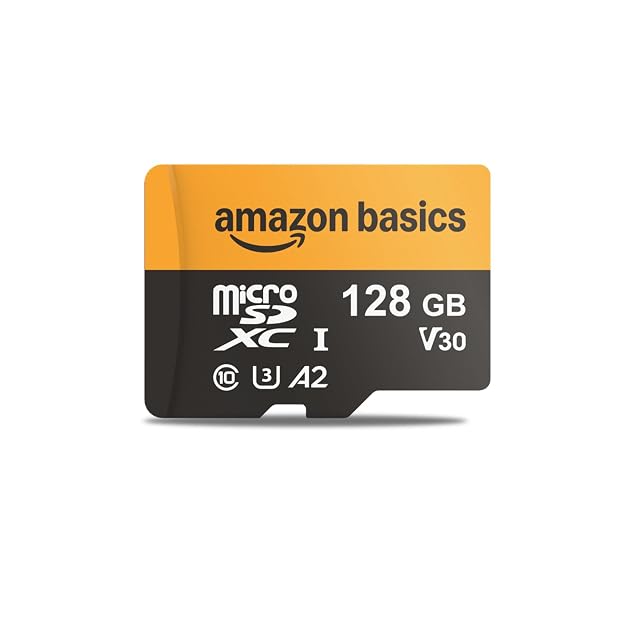
  2. Amazon Basics 128 GB microSDXC card with adapter

    Amazon Basics 128 GB microSDXC

    The cheap 128 GB option, quoted at up to 200 MB/s read. Like every general-purpose card it is built for mixed use rather than for the constant rewriting a camera does.

    Capacity
    128 GB
    Read speed
    Up to 200 MB/s, stated by the manufacturer
    Supplied
    SD adapter
    Endurance
    General purpose
    Amazon reference
    B0DB5BW783
    EAN
    0195515054850
    • Cheaper than the 256 GB cards here
    • 200 MB/s read stated — faster on paper than the SanDisk beside it
    • General purpose, not high endurance

    Best for: A second camera, a spare card, or a trail camera that is emptied and reused.

    ≈ $45
    Check price on Amazon
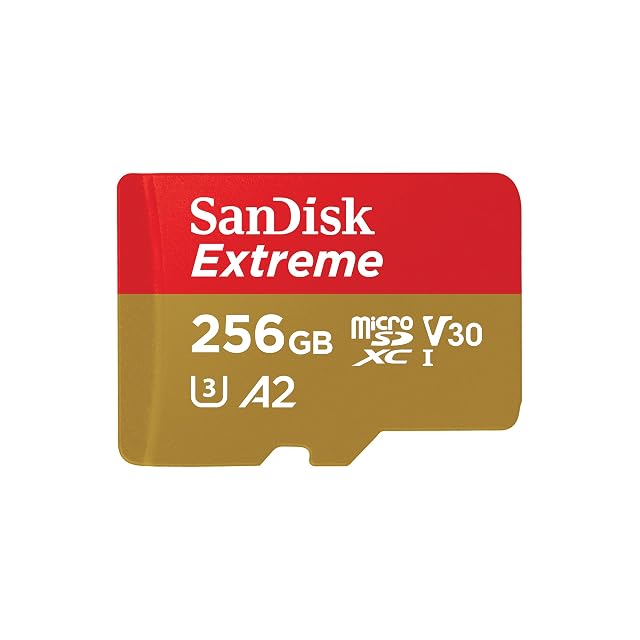
  3. SanDisk Extreme 256 GB microSDXC card

    SanDisk Extreme microSDXC 256 GB

    Twice the capacity of the 128 GB card, which in a camera translates directly into twice the days of history before the oldest footage is overwritten.

    Capacity
    256 GB
    Read speed
    Up to 190 MB/s, stated by SanDisk
    Write speed
    Up to 130 MB/s, rated V30, stated by SanDisk
    Class
    A2 application performance
    Supplied
    SD adapter
    Endurance
    Standard — not a high-endurance card
    Amazon reference
    B09X7CRKRZ
    EAN
    0619659188504
    • Doubles the retention window over a 128 GB card
    • Same SanDisk build and 190 MB/s read figure
    • Some older cameras cap at 128 GB — check before buying

    Best for: A camera whose card fills before you get round to looking at it.

    ≈ $66
    Check price on Amazon
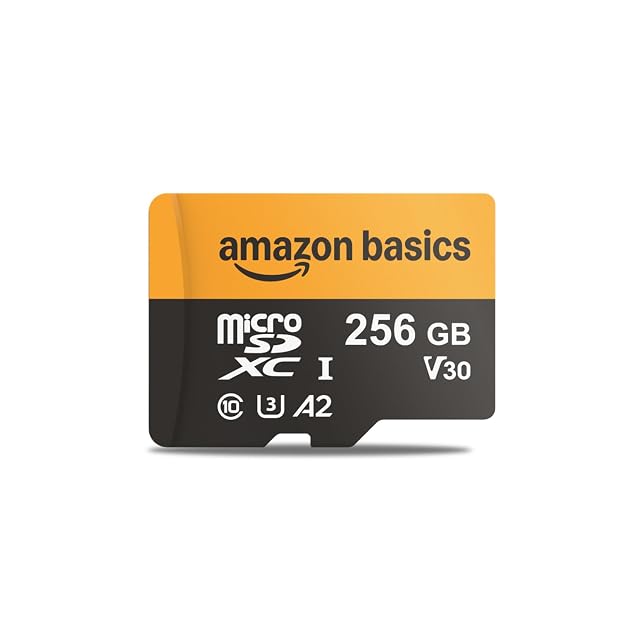
  4. Amazon Basics 256 GB microSDXC card

    Amazon Basics 256 GB microSDXC

    The same capacity as the SanDisk Extreme at the same price. Choose on availability and on which brand you would rather trust in a camera you will not check for months.

    Capacity
    256 GB
    Read speed
    Up to 200 MB/s, stated by the manufacturer
    Supplied
    SD adapter
    Endurance
    General purpose
    Amazon reference
    B0DB54VLNC
    EAN
    0195515054874
    • 256 GB at a price that tracks the SanDisk closely
    • 200 MB/s read stated
    • General purpose, not endurance rated

    Best for: Anyone comparing the two 256 GB cards on this page and finding the SanDisk out of stock.

    ≈ $72
    Check price on Amazon
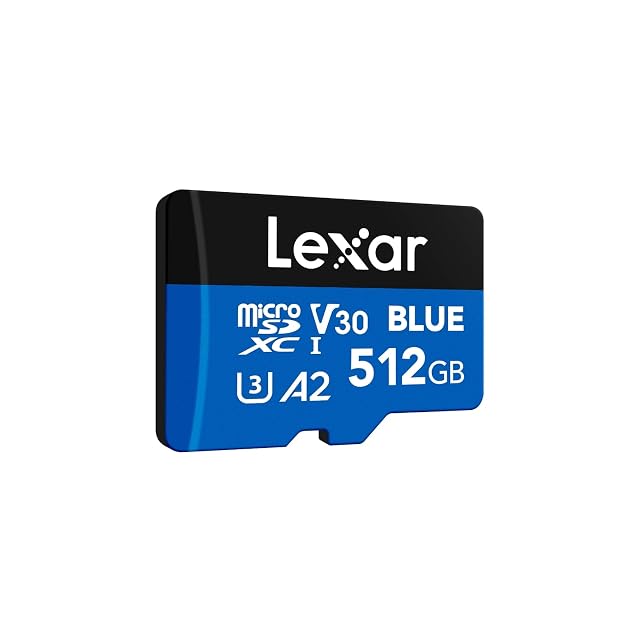
  5. Lexar Blue 512 GB microSDXC memory card for security cameras

    Lexar Blue microSDXC 512 GB

    The only 512 GB card on this shelf, for the cameras that state 512 GB as their limit. Lexar lists up to 160 MB/s read, A2 and IPX7; it had no US seller when we checked.

    Capacity
    512 GB
    Read speed
    Up to 160 MB/s, stated by Lexar
    Write speed
    Not stated on the listing
    Bus
    UHS-I
    Class
    A2
    Durability
    IPX7 waterproof, temperature-, X-ray- and shock-resistant (1.5 m drop), stated by Lexar
    Endurance rating
    None stated, general purpose
    Amazon reference
    B0DSVTSTY4
    EAN
    4895217918493
    • 512 GB, the highest limit cameras in this catalog publish
    • The longest recording window you can fit in one of those cameras
    • No US seller on Amazon.com when we last checked

    Best for: A camera whose maker states 512 GB support, recording continuously, where a long recording window is the point.

    Check price on Amazon

The need before the model, across camera memory cards

Keeping footage for longer

Capacity decides how long recording lasts before being overwritten. In high definition it is used up far faster than you would imagine.

Lexar Blue microSDXC 512 GB

Keeping up with the write rate

A card that is too slow causes gaps and corrupt files in continuous recording. Write speed is what counts, not the read speed in the headline: the SanDisk Extreme 256 GB states 130 MB/s and V30; the Amazon Basics cards do not publish their write speed.

SanDisk Extreme microSDXC 256 GB

A camera that records on events

No card on this page is high-endurance; for continuous recording, look for one that states its hours. On events, writing stays moderate and a general-purpose card holds up: the SanDisk Extreme 128 GB states V30 and 90 MB/s write, and almost every camera accepts 128 GB.

SanDisk Extreme microSDXC 128 GB

Who buys what, across camera memory cards

Camera recording continuously
Permanent writing wears a card out far faster than photographic use. Cards designed for surveillance exist for that.
Recording on detection
The wear is far lower and an ordinary card holds up better. Capacity then matters more than endurance.
Trail camera
Cold and damp are added to the mix. A quality card limits corrupted files after weeks outdoors.

Nothing is free: the trade-offs of camera memory cards

Maximum capacity against compatibility
Every camera has a maximum recognized capacity. A larger card may not be seen at all, which is not always clearly signalled.
Ordinary card against endurance card
A conventional photo card wears out fast under continuous writing and ends up corrupting files; endurance cards are designed for that cycle.
Price against reliability
Very cheap cards state capacities they do not always have. On a security recording, the failure is discovered at the worst moment.

Buyers’ questions on camera memory cards

Do I need a card specifically for surveillance?

In continuous recording, yes: permanent writing wears a photo card out far faster. Endurance cards are designed for that cycle.

Does the camera recognize every capacity?

Each model has a stated limit. Beyond it, the card may not be seen, sometimes with no clear message.

Should the card be formatted in the camera?

Yes, every time: formatting by the camera guarantees the right file system and the expected structure.

What does the speed class mean?

A guaranteed minimum write rate. In continuous video recording, an insufficient rate causes dropouts and corrupted files.

How often should the card be replaced?

It has a limited number of write cycles. A card several years old in continuous recording has to be regarded as suspect.

How do I know a card is failing?

Missing files, truncated sequences or a camera asking to format again. Those symptoms precede complete failure.

Can the card be read on a computer?

Generally yes, with a suitable reader. Some recorders use a proprietary format requiring their software.

How do you know a card is failing?

Recordings cut out, files become unreadable and the camera reports an error on formatting. A surveillance card is replaced after two years, before its failure is discovered at the worst moment.

What to take away from camera memory cards

Continuous recording wears a photo card out far faster than normal use: endurance cards exist for that cycle. Always format in the camera, check the maximum recognized capacity — and a card several years old under continuous writing is suspect.

The gist of camera memory cards, at a glance

  • Highest figure for capacity: Lexar Blue microSDXC 512 GB (512 GB).
  • Highest figure for read speed: Amazon Basics 256 GB microSDXC (Up to 200 MB/s, stated by the manufacturer).

A comparison of camera memory cards

A characteristic has to come from four devices in five to hold a column. Below that, we would be lining up empty cells.

ModelPriceCapacityRead speedEnduranceSupplied
SanDisk Extreme microSDXC 128 GB$41128 GBUp to 190 MB/s, stated by SanDiskStandard — not a high-endurance cardSD adapter
Amazon Basics 128 GB microSDXC$45128 GBUp to 200 MB/s, stated by the manufacturerGeneral purposeSD adapter
SanDisk Extreme microSDXC 256 GB$66256 GBUp to 190 MB/s, stated by SanDiskStandard — not a high-endurance cardSD adapter
Amazon Basics 256 GB microSDXC$72256 GBUp to 200 MB/s, stated by the manufacturerGeneral purposeSD adapter
Lexar Blue microSDXC 512 GB—512 GBUp to 160 MB/s, stated by Lexar——

Sources, and how we judge

Specifications: manufacturer sheets for home security products and the matching Amazon product pages. Prices and availability: Keepa. Every figure in this table names its source.

Most recent revision in this category: October 19, 2026.

What we look at on camera memory cards

Prices quoted in these summaries are dated readings. The live price is shown next to each product.