No mains, no network, and it runs for a season on AA cells · review
Lutranstra D909 review
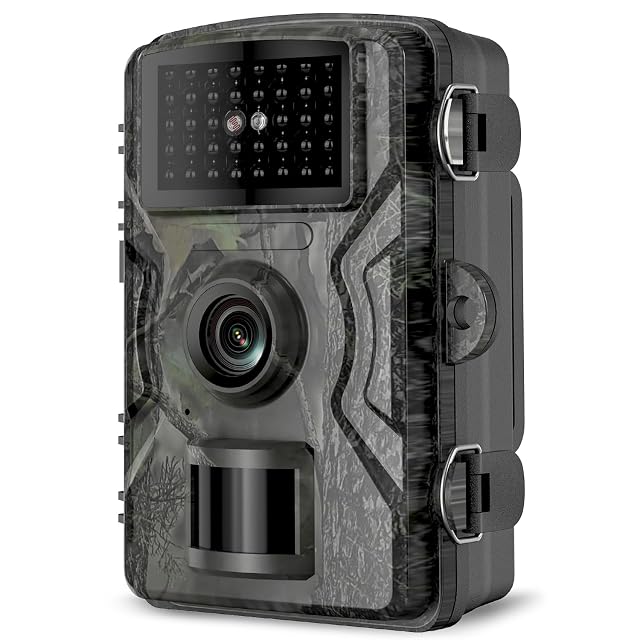
The higher-resolution of the two Lutranstras here: 5K video and 64 MP stills behind a 130° lens, with the same local Wi-Fi app transfer, and a box that includes both a 32 GB card and eight AA batteries.
The conclusion The wide-angle option in this hub. Excellent for a yard, the wrong tool for identifying somebody at the far end of a track.
Trail cameras nearly all use a similar field of view. This one is noticeably
wider — 130° — and that single specification decides what it is good for.
Wide versus narrow, plainly
A 130° lens strapped to a post covers a yard: the gate, the path, the shed
door and the space between them, all in one frame. A narrower lens covers the
path and puts three or four times the detail on whoever is on it.
If the question is “what happened in this yard”, wide wins. If it is “who was
that”, wide loses, and no amount of resolution compensates — a 5 MP sensor spread over
130° still puts fewer pixels on a face at fifteen meters than the same sensor over 60°
does.
The box
A 32 GB card and eight AA cells, which makes it usable the moment it arrives.
Use the cells for setup and then replace them: they are alkaline, and alkaline
chemistry loses most of its capacity below freezing. A camera left out through
a winter wants lithium AAs, and the difference is a season rather than a month.
The app
Identical to the 4K model in this hub: a local hotspot, joined at the camera,
with the images pulled to a phone. Convenient, battery-hungry, and no
substitute for a SIM if the camera is somewhere you cannot easily visit. The listing adds a Bluetooth connection and a range of about 20 m (65 ft) in the open.
Who it suits
A wide, contained scene where coverage is the point.
Availability
Not found on the American Amazon store, where the buy link falls back to a local search rather than to a page that does not exist.
Prices and availability are what Keepa reported on the date this page was updated; both move.
What reassures, and what does not
Strengths
130° lens covers a much wider scene than the usual trail-camera view
5K video from a 5 MP sensor, with 64 MP stills
Card and eight AA cells both supplied — genuinely ready to use
Trigger stated under 0.1 s, with two PIR sensors
Compromises
A wide lens spreads detail: a distant subject is smaller than on a narrow lens
Supplied AA cells are alkaline, which is the wrong chemistry for winter
850 nm infrared: a faint red glow shows up close, unlike the 4K model’s 940 nm
No SIM and no cloud: local Wi-Fi or Bluetooth, about 20 m in the open
Where this model stands apart
Weighed against the median of its own range on this site — not against the security market at large.
Video5K UHD from a 5 MP sensor, 64 MP stills, stated by Lutranstra25% above the median of this range
Night illumination850 nm infrared, a faint red glow visible up close10% below the median of this range
Specifications
Video
5K UHD from a 5 MP sensor, 64 MP stills, stated by Lutranstra
Lens
130° wide angle
Night illumination
850 nm infrared, a faint red glow visible up close
Supplied
32 GB card, 8 × 1.5 V AA cells, strap and metal mount
Connection
Local Wi-Fi hotspot or Bluetooth, with the TrailCam Go app; about 20 m (65 ft) in the open
Weather rating
IP66, −30 °C (-22 °F) to 70 °C (158 °F) stated
Trigger speed
Under 0.1 s with two PIR sensors, stated by Lutranstra
Amazon reference
B0FCBZ7LQB
EAN
0793313434326
The questions we are asked
Is a 130° lens better?
It is different, and the trade is worth understanding. A wide lens sees a whole yard from one strap and puts fewer pixels on anything within it; a narrower lens sees a path and puts far more detail on whoever is walking down it. Wide for coverage, narrow for identification.
Should I use the supplied batteries?
Use them to set the camera up, then replace them for anything left out through winter. Alkaline cells lose most of their capacity below freezing, and a trail camera reporting low battery in November is almost always running on alkalines rather than lithium.
Is 5K meaningfully better than 4K?
Marginally, and on a 130° lens the extra resolution is spread across a much wider scene. Judge this camera on the lens rather than on the number: the width is what it is for.
Our score
7.8/ 10
The wide-angle option in this hub. Excellent for a yard, the wrong tool for identifying somebody at the far end of a track.
What this one costs among trail cameras
A reference exists on these Amazon stores: France, Germany, Italy, Spain, United Kingdom. Listed is not the same as in stock — availability changes daily.
Details checked on September 2, 2026.
The buyer this one serves, among security devices
A wide scene — a yard, a clearing, a gate with a track either side — where the lens matters more than the reach.
Sources
Specifications: the manufacturer sheet for home security products and the matching Amazon product page. Prices and availability: Keepa. Every figure on this page names its source.
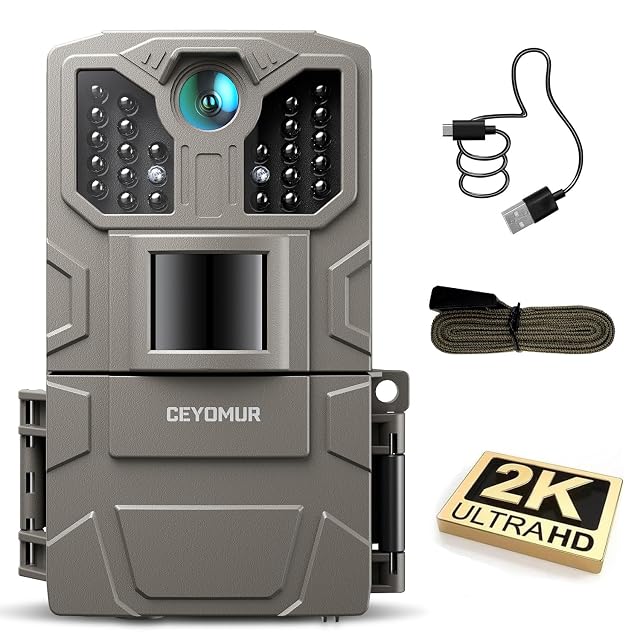
2K video · 24 × 850 nm IR LEDs · IP66 · camouflage housing · keyhole lock point
A camouflaged trail camera with 24 infrared LEDs at 850 nm and a front-opening body. CEYOMUR states 2K video with audio, an IP66 housing and a built-in keyhole for a lock.
Best for: A shed, a gate on a track or a plot with no power, where the camera should not be obvious.
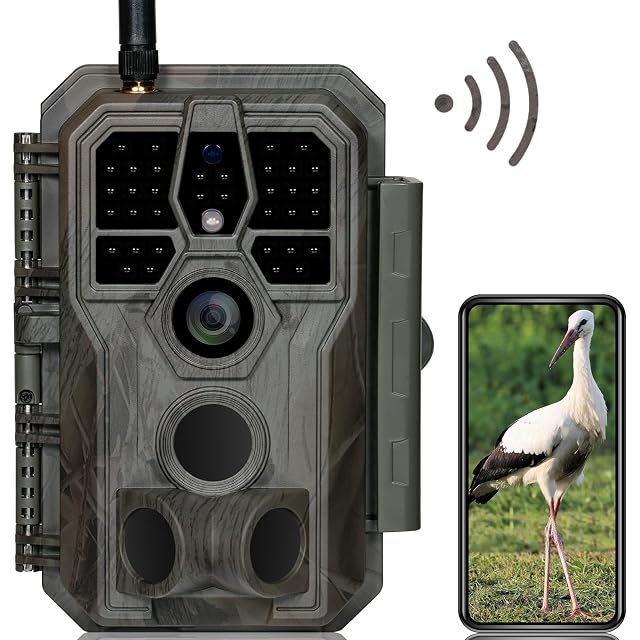
64MP stills · 1296p H.264 video · Bluetooth and Wi-Fi pairing · 36 × 940 nm LEDs · no monthly fee
GardePro pairs by Bluetooth before switching to Wi-Fi, which removes the step where trail-camera apps usually fail. It states 64 MP stills, 1296p H.264 video, 36 no-glow LEDs and an external high-gain antenna, with no subscription.
Best for: Anyone who has already given up on a trail camera app once.
4K · 32MP · 940 nm no-glow to 24 m (79 ft) · 0.1–0.3 s trigger · −29 to 21 °C (-20 to 70 °F) rated · IP66
HSSNS states 4K video, 940 nm no-glow night vision to 24 meters (79 ft), a trigger of 0.1 to 0.3 seconds with three-shot bursts, and operation rated from −29 °C (−20 °F) to 21 °C (70 °F), with a 2.4-inch color screen and password protection.
Best for: A cold, exposed position where the camera has to keep working through a winter.