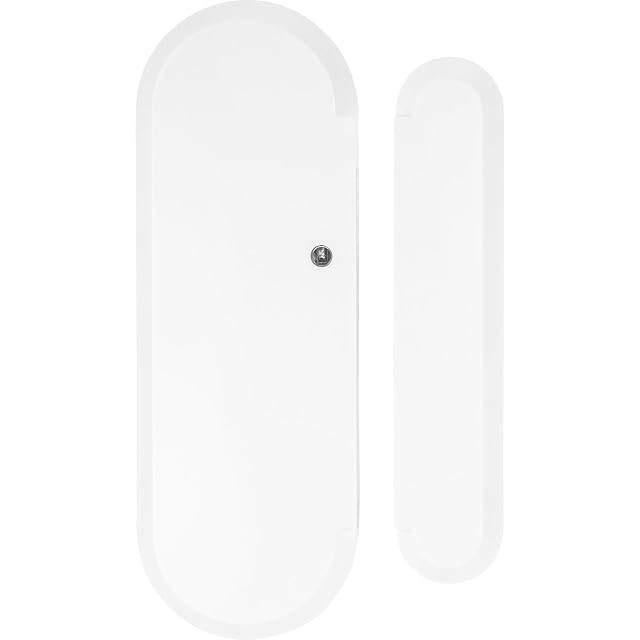
The conclusion The only sensor on this shelf that works out of the box with nothing else bought: six openings covered, alerts on a phone, no hub, and professional monitoring available without a long contract. For a house with no alarm, eighty dollars is the whole system, and the twenty-dollar premium over Ring's hub-dependent sensors is the cheapest part of that decision. The catch is honest and it is in Ring's own words: Sidewalk coverage may vary. Nothing at all is published about the battery.
What the maker puts in writing
6-pack · protect entry points with instant alerts
Instantly detects when a window or door opens
No base station required — connects over Amazon Sidewalk (Sidewalk required for use; coverage may vary)
Mounts in minutes, no tools or wiring
24/7 Pro Monitoring with a compatible Ring subscription, no multi-year contracts
No battery type. No battery life. No gap tolerance. No tamper detection.
No hub, which changes the price of everything
And it is the only sensor here that can say it.
Ring’s other sensors on this shelf are ten dollars each and require a base station
that is not in the box — and the alarm kits that carry one start at two hundred
dollars.
These are thirteen each and need nothing.
For a house with no alarm, eighty dollars is the whole system. The twenty-dollar
premium is the cheapest part of the decision.
Sidewalk, and what “coverage may vary” means
The only named network on this shelf, and the condition attached to it.
Amazon Sidewalk is a shared low-bandwidth network carried by Echo speakers and
Ring devices — including other people’s — relaying small amounts of data for
devices nearby.
That is how a sensor reaches the internet with no hub of yours. It also means the
link depends on Sidewalk devices being in range, which is a function of your
neighbors.
Dense suburb: likely fine. Isolated property with no Echo of your own: possibly
not at all.
The page will not tell you which you are.
And nothing about the battery
Which Ring publishes two listings away on this same shelf.
Two CR2032 cells and about three years, on the second-generation sensor.
Here: no type, no count, no life, no statement of whether any are included.
Long-range radio costs more power than a short hop to a hub, so do not assume
three years.
Six sensors with unknown cells is six unknowns in a year.
Availability
On sale at around $80 on the American Amazon store at the time of checking.
Prices and availability are what Keepa reported on the date this page was updated; both move.
Prices quoted in this text were read on October 8, 2026. The live price is at the top of the page.
What reassures, and what does not
Strengths
No base station required, which removes a two-hundred-dollar prerequisite
The only named network on this shelf: Amazon Sidewalk
Six sensors covering six openings out of one box
Professional monitoring available with no multi-year contract
No tools and no wiring
Works as a first alarm purchase rather than an addition to one
Compromises
Sidewalk coverage is stated to vary and depends on nearby devices you do not own
Nothing published about the battery: type, count, life or inclusion
Eighty dollars for six, against sixty for Ring's base-station sensors
No gap tolerance
No local siren, so an unnoticed alert is a silent break-in
Five bullets, none of which is a measurement
Specifications
Platform
No base station required: the sensors connect over Amazon Sidewalk, stated, with Sidewalk required for use and coverage stated to vary. It is the only network named anywhere on this shelf, and it removes the one condition that makes Ring's other sensors a larger purchase
Protocol
Amazon Sidewalk — a long-range, low-bandwidth network carried by other people's Echo and Ring devices in the neighborhood. That is what coverage may vary means: the link depends on Sidewalk devices being nearby, which is outside your control
Type
A system sensor that reports to an app rather than sounding where it is fitted. No local siren
System
24/7 professional monitoring with emergency response for break-ins and fires is available on a compatible Ring subscription with no multi-year contracts — stated as sold separately
Mounting
Mounts in minutes with no tools and no wiring, stated
Power
Not published. No cell type, no count, no stated life and no statement of whether batteries are included — where Ring's own second-generation sensor on this shelf publishes two CR2032 cells and about three years
Gap tolerance
Not published, as on at least six of the twelve listings on this shelf
Tamper
Not published
Metal frames
Not published
Amazon reference
B0FP6HGFXW
EAN
0840414688728
The questions we are asked
What is Amazon Sidewalk and should I rely on it?
A shared low-bandwidth network carried by Echo speakers and Ring devices, which relay small amounts of data for nearby devices — including other people's. That is how a sensor reaches the internet with no hub of your own, and it is why Ring writes coverage may vary: the link depends on Sidewalk-enabled devices being in range, which is a function of your neighbors rather than your house. In a dense suburb it is likely fine. In an isolated property with no Echo of your own it may not work at all, and the page will not tell you which you are.
Why does it cost more than the base-station version?
Eighty dollars against sixty for six, and the twenty dollars buys independence rather than hardware. Ring's second-generation sensors are ten dollars each and need a base station that does not come in the box; these are thirteen each and need nothing. If you own a Ring Alarm already, the cheaper sensors are the obvious purchase. If you do not, this pack is the whole system for eighty dollars rather than eighty plus two hundred — which makes the twenty-dollar premium the cheapest part of the decision.
What about the battery?
The page says nothing, which is a real gap given Ring publishes two CR2032 cells and about three years on its own second-generation sensor two listings away on this shelf. No cell type, no count, no life, and no statement of whether any are in the box. Long-range radio generally costs more power than a short hop to a hub, so three years should not be assumed here. Ask before buying six, because six sensors whose cells are unknown is six unknowns in a year's time.
Against the rest of the door and window sensors
Between security devices of the same category and nearby price. Shown: what they all state. A half-filled column says nothing.
Model
Price
Type
Mounting
Power
Gap tolerance
Ring Window and Door Sensor (newest model), 6-pack, no base station
$80
A system sensor that reports to an app rather than sounding where it is fitted. No local siren
Mounts in minutes with no tools and no wiring, stated
Not published. No cell type, no count, no stated life and no statement of whether batteries are included — where Ring's own second-generation sensor on this shelf publishes two CR2032 cells and about three years
Not published, as on at least six of the twelve listings on this shelf
A system contact sensor, not a standalone alarm. It makes no noise of its own: the opening is reported to the base station, which sounds the siren and raises the alert. At least five of the twelve sensors on this shelf are the opposite — a screamer on the frame reporting to nobody
Mounts to door and window frames with no tools required, stated. The second generation is stated to be smaller than the first, which Ring says enables more placement options
Two 3 V CR2032 cells per sensor, included, with approximately three years of stated life. It is the longest battery life published on this shelf by a factor of nearly three, and one of only two figures here
Not published. This shelf's introduction calls this the specification that decides whether a sensor works on your window, and Ring gives no figure — which matters more on a slim sensor, since a smaller magnet generally means a shorter reach
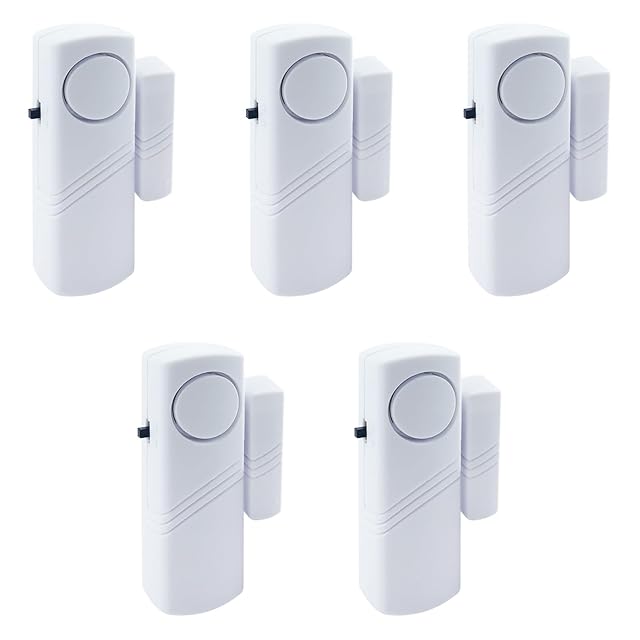
A standalone alarm: the magnet separates, the unit sounds where it is fitted, and nothing is reported remotely. No app, no radio, no base station
3M double-sided tape on the back, with the switch set after sticking. SanJie recommends installing indoors — the only placement advice on this shelf
Three LR44 button cells, SUPPLIED, with a normal life of up to 13 months and a flashing indicator when low — stated. It is one of only two listings on this shelf with a battery life figure, and one of four where the cells are in the box
Not published. This shelf's introduction calls it the specification that decides whether a sensor works at all, and one listing on this shelf publishes a figure
A standalone alarm: the magnetic switch detects the opening, the unit sounds at 90 dB where it is stuck, and nothing is reported anywhere else. No app, no radio, no base station
Adhesive, with an on/off switch pressed before the cells go in, then the double-sided tape peeled and the unit stuck to the frame — stated
Two AAA cells per unit, stated NOT included. Fifteen units is thirty AAA cells to buy before anything works, which is a real cost against a twenty-one dollar price
Not published. One listing on this shelf publishes a figure — 0.6 in — and this shelf's introduction calls it the specification that decides whether a sensor works at all
What separates the models, in security devices
If price decides: WimuPath Door and window alarm, 15-pack, 90 dB, at $21.
What this one costs among door and window sensors
Details checked on October 8, 2026.
The buyer this one serves, among security devices
A house with no alarm system that wants phone alerts on six openings and nothing else to buy
What buyers actually choose
Amazon reports what buyers took in the month before this page was last checked: at least 2,000.
The figure is a floor, rounded by Amazon, and read through Keepa — it says what buyers picked, not what a maker claims.
Sources
Specifications: the manufacturer sheet for home security products and the matching Amazon product page. Prices and availability: Keepa. Every figure on this page names its source.
For Smartvest Pro · wireless opening detector · triggers configured scenarios · doors and windows
The opening detector for ABUS's Smartvest Pro alarm. It reports unauthorized opening of doors, windows and patio doors, and triggers whatever scenarios have been configured on the panel.
Best for: An ABUS Smartvest Pro system being extended door by door.
90 dB standalone siren · 3.54 × 1.18 × 0.79 in and about 0.08 lb, both published · 2 AAA, NOT included · a three-step install written out · five units for ten dollars · no gap figure, no battery life, no tamper detection
Five alarms for ten dollars with their dimensions and weight published — two figures the cheapest sirens here usually leave out.
Best for: Five openings on a tight budget, where the body has to be measured against a shallow frame first
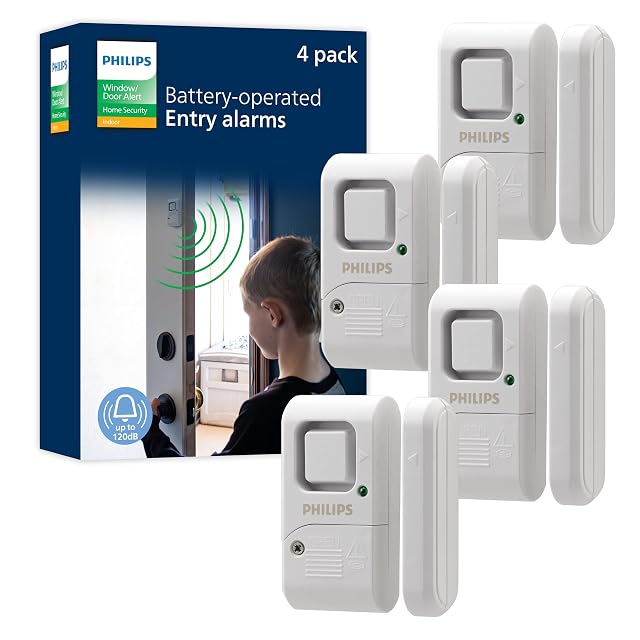
120 dB alarm or chime, switched on the side: OFF / chime / alarm · 4 LR44 cells SUPPLIED · a battery TEST BUTTON and a low-battery LED, the only test button on this shelf · double-sided tape included · no gap figure, no battery life, no tamper detection
The only sensor here with a button that tells you the battery is still good — which on an alarm nobody checks is worth more than it sounds.
Best for: A household that wants a chime for the back door in the day and an alarm on it at night