The conclusion Six dollars eighty a lock for solid brass — body and shackle both — which is precisely the material this shelf's introduction above asks for on anything facing weather, and the only solid brass on this shelf. A lock that still turns next March is worth more on a garden gate than a plated one rusted shut. Brass is softer than hardened steel against a cutter, no diameter is published, there is no cylinder detail at all, and every bullet ends with the word "steady".
“A durable brass body and shackle resist corrosion so these padlocks with keys stay smooth through rain”
Keyed alike: all padlocks share one master key cut
For gym locker, shed, gate, or toolbox
All five bullets end with the word “steady”
No shackle diameter. No cylinder detail. No shrouding.
The material the shelf asks for
And the only lock here that has it.
This shelf’s introduction: outdoors, the second question is corrosion — a brass or
stainless body on a gate that faces weather, rather than a plated steel one that
will seize by spring.
This is solid brass, body and shackle. Nothing else on this shelf is.
Plating is a skin, and it scratches
Which is why cheap all-weather locks fail.
A key dragged across a plated body, a knock against a hasp, a season of grit. The
coating goes in a few places.
Corrosion starts at exactly those points and works inwards — usually at the
shackle hole and the keyway.
Solid brass has nothing to lose. It dulls, it goes green at the edges, and it
keeps turning.
And brass is softer
Which is the trade, stated plainly.
Hardened steel is substantially harder. A brass shackle of the same section cuts
and saws more easily, and the boron-shackled lock on this shelf is in another
class.
What brass buys is the failure this shelf’s introduction actually warns about: a
steel lock rusted shut in March, which locks you out rather than a thief.
For a garden gate, that is the likelier problem.
What the page will not tell you
The cylinder, and the section.
No pin count. No pick resistance. No mechanism. No shackle diameter — which
matters more on a softer metal, not less.
What it does say, twice, is the material. Read this as a weather lock rather than
a security lock.
Availability
On sale at around $14 on the American Amazon store at the time of checking.
Prices and availability are what Keepa reported on the date this page was updated; both move.
Prices quoted in this text were read on October 8, 2026. The live price is at the top of the page.
What reassures, and what does not
Strengths
Solid brass body and shackle, the only one on this shelf
No coating to lose, so no rust starting from a scratch
Keyed alike across the pack
About six dollars eighty a lock, the cheapest keyed lock here
A chamfered body, which sheds water rather than holding it
The right material for the job this shelf's introduction describes
Compromises
A brass shackle is softer than hardened steel against a cutter
No shackle diameter, which matters most on a softer metal
No cylinder detail at all: no pin count, no pick resistance
No shrouding and no closed shackle
Keyed alike is permanent: one lost key compromises both locks
Every bullet ends with the word "steady"
Specifications
Body
Solid brass, 40 mm (1.57 in), with a chamfered edge — stated. This shelf's introduction asks for a brass or stainless body on a gate that faces weather rather than a plated steel one that will seize by spring, and this is the only solid brass body on this shelf
Shackle
Brass, stated: a durable brass body AND shackle resisting corrosion. That is the unusual half — most weatherproof padlocks pair a brass body with a steel shackle. Brass is softer than hardened steel, so this trades cut resistance for a lock that will still turn after a winter
Diameter
Not published. This shelf's introduction calls diameter in millimeters the first specification that matters, and at least six of the fourteen padlocks here omit it — which matters more on a brass shackle than a steel one, because the section is doing more of the work
Weather
All-weather, stated, with the corrosion resistance coming from the material rather than a coating. A plated lock loses its plating at the first scratch and then rusts from that point; solid brass has no coating to lose
Keys
Keyed alike across the pack: all padlocks share one key cut, stated for several lockers and single-key management. At least three of the fourteen padlocks on this shelf are keyed alike
Supplied
Two padlocks, stated, at thirteen dollars fifty-eight — about six dollars eighty each, the lowest per-lock price on this shelf
Cylinder
Not published. No pin count, no pick resistance claim and no mechanism description appears
Shrouding
Not published. No closed shackle and no shield, so the shackle is exposed
Copy
All five bullet points end with the word "steady" — "everyday storage steady", "locks for storage steady", "single-key management steady", "every day steady", "many buyers love steady". It is keyword residue rather than a specification
Amazon reference
B072MLBGW4
EAN
0670534096987
The questions we are asked
Is brass strong enough?
Not against a cutter, and that is the honest trade. Hardened steel is substantially harder than brass, so a brass shackle of the same section is easier to cut and saw — the lock on this shelf with a boron shackle is in another class entirely. What brass buys is the failure this shelf's introduction actually warns about: a plated steel lock on a weather-facing gate seizes by spring, and then it is you who cannot open it. A brass lock that still turns in March is doing more for a garden gate than a steel lock welded shut by rust.
Why does solid brass beat a brass-plated lock?
Because plating is a skin and it gets scratched. A key dragged across a plated body, a knock against a hasp or a season of grit takes the coating off in a few places, and corrosion then starts at exactly those points and works inwards — which is why cheap all-weather locks fail at the shackle hole and the keyway. Solid brass has no coating to lose: it dulls, it goes green at the edges, and it keeps working. SEPOX states the body and the shackle are both brass, which is the version worth paying for.
What does the page not tell me?
The cylinder, and the shackle section — the two things that describe how hard the lock is to defeat. There is no pin count, no pick resistance claim, no mechanism description and no shackle diameter, and all five bullets are written in marketing copy that ends every sentence with the word "steady". What the page does tell you is the material, twice, and the material is the one thing on this shelf that answers the introduction's second question. Read it as a weather lock rather than a security lock.
Against the rest of the padlocks
Between security devices of the same category and nearby price. Shown: what they all state. A half-filled column says nothing.
Model
Price
Body
Shackle
SEPOX 40 mm all-weather solid brass padlock, keyed alike, 2-pack
$14
Solid brass, 40 mm (1.57 in), with a chamfered edge — stated. This shelf's introduction asks for a brass or stainless body on a gate that faces weather rather than a plated steel one that will seize by spring, and this is the only solid brass body on this shelf
Brass, stated: a durable brass body AND shackle resisting corrosion. That is the unusual half — most weatherproof padlocks pair a brass body with a steel shackle. Brass is softer than hardened steel, so this trades cut resistance for a lock that will still turn after a winter
40 mm (1.57 in), stated in the title. No material and no construction — not laminated, not die-cast, not brass
Hardened, stated. No diameter, no alloy and no length appears. Mindy describes the lock as professional grade hardened BASE METAL, which is not a material: base metal means any non-precious metal
40 mm (1.57 in) zinc die-cast. Die-cast zinc is the weaker of the two body constructions on this shelf — laminated steel resists a hammer better — and it is lighter and does not rust
Zinc-plated hardened steel, stated for cut resistance. No diameter is published, as on at least six of the fourteen padlocks here
A gate, a meter box or a garden store that faces weather and has to open next spring
What buyers actually choose
Amazon reports what buyers took in the month before this page was last checked: at least 100.
The figure is a floor, rounded by Amazon, and read through Keepa — it says what buyers picked, not what a maker claims.
Sources
Specifications: the manufacturer sheet for home security products and the matching Amazon product page. Prices and availability: Keepa. Every figure on this page names its source.
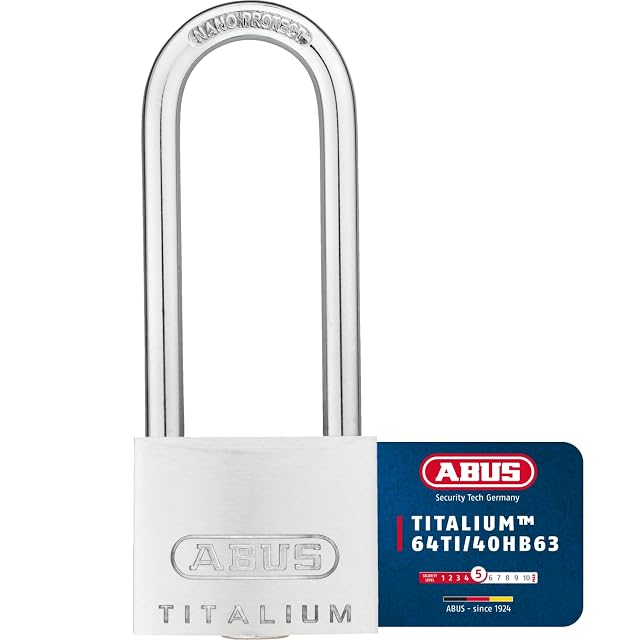
6.5 mm (0.26 in) shackle · 63 mm (2.48 in) high shackle · Titalium body, 107 g (3.8 oz) · paracentric key · ABUS level 5
ABUS's everyday Titalium padlock with a high 63 mm (2.48 in) shackle: a special-aluminum body at 107 grams, a hardened steel shackle, a paracentric keyway against manipulation, and double shackle locking.
Best for: Doors, lockers and tool boxes where the lock is carried, opened often, and left outdoors between times.
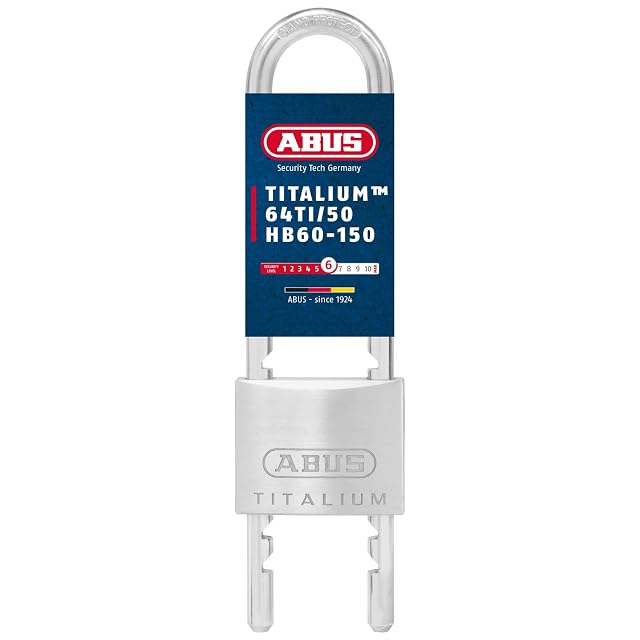
8 mm (0.31 in) shackle · extendable 60–150 mm (2.36 to 5.91 in) shackle · 281 g (9.9 oz) · paracentric key · ABUS level 6
ABUS's cellar padlock: an 8 mm (0.31 in) hardened shackle that extends from 60 to 150 mm (2.36 to 5.91 in), in a 281 g (9.9 oz) Titalium body, with a paracentric keyway and double shackle locking.
Best for: A hasp or a bracket where nothing standard reaches — cellar doors, old gates, awkward ironwork.
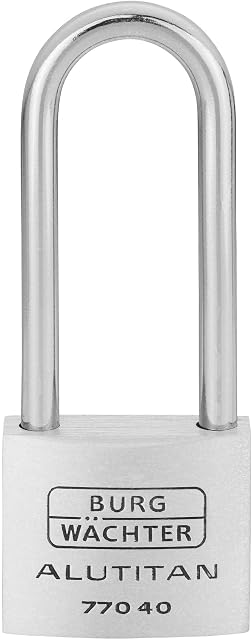
6.9 mm (0.27 in) shackle · aluminum body · high shackle, 22.3 mm (0.88 in) wide · double locking · 2 keys
A light aluminum-bodied padlock with a 6.9 mm (0.27 in) hardened shackle and a high shackle 22.3 mm (0.88 in) wide. BURG-WÄCHTER states double shackle locking and two keys.
Best for: A gate latch or a barrier where the shackle must reach through something thick, and the value behind it is modest.