The conclusion Two horns for fifteen dollars is the right purchase on this shelf, because this shelf's introduction above says a siren does two jobs — clearing the house and telling the street — and one horn placed in one place cannot do both. Dual tone is a real advantage over the single notes here, and the ABS flame-retardant shell is the claim that matters on a wired device. A hundred and ten decibels is the lowest figure here, no bracket is mentioned, and there is no tamper switch, battery or strobe.
What the maker puts in writing
2 pack · DC 12V · 110 dB
“110DB Alarm: High volume and DUAL TONE, can work with various alarm connections”
Working voltage: DC6 to 12V · rated power: 15W
ABS flame retardant shell, low power consumption, simple wiring
For DIY security systems or replacements
No current. No dimensions. No bracket. No tamper switch. No backup battery. No
strobe.
Two horns, two jobs
Which is the argument, and it is the shelf’s own.
This shelf’s introduction: a siren does two jobs at once — it makes the house
unpleasant to remain inside, and it tells the street which house is calling.
One horn in one place does one of them.
An indoor siren clears a house and is inaudible three doors away. An outdoor one
under an eave carries, and does little to the intruder’s ears.
Two at seven dollars fifty each is the cheapest way on this shelf to do both
properly. A hundred and ten decibels in two places beats a hundred and twenty in
one.
Dual tone gets noticed
Which the other three cannot say.
A single steady note is easy to filter and easy to mistake for a van reversing or
a smoke alarm.
Two alternating tones hold attention and read unambiguously as an alarm. They also
travel differently through a building: a changing pitch finds its way round
corners better than a fixed frequency, because some frequencies are absorbed more
than others.
This is the only listing of the four to say anything about the character of the
sound rather than its size.
And no bracket
Which the page does not mention at all.
Two sirens on this shelf state a bracket, one of them iron.
A horn mounts through its own flange if it has one, or sits in an enclosure. On a
pair meant for two rooms you want two fixings.
Check the images, or budget a few dollars. It is the kind of detail that stops an
evening’s work.
Availability
On sale at around $15 on the American Amazon store at the time of checking.
Prices and availability are what Keepa reported on the date this page was updated; both move.
Prices quoted in this text were read on October 8, 2026. The live price is at the top of the page.
What reassures, and what does not
Strengths
Two sirens for fifteen dollars, about seven fifty each
Dual tone, which nothing else on this shelf offers
ABS flame-retardant shell
Accepts 6 to 12 V, so it suits a sagging panel output
Low power consumption claimed, with simple wiring
Sold as a DIY or replacement part, which is exactly what it is
Compromises
A hundred and ten decibels, the lowest on this shelf
No bracket mentioned
No current figure, so the 15 W is unverifiable
No dimensions
No tamper switch, backup battery or strobe
Four bullets, one of which is an application note
Specifications
Supplied
Two sirens, stated, at fourteen dollars ninety-seven — about seven dollars fifty each, the lowest per-siren price on this shelf and the only multipack here
Sound level
110 dB, dual tone — stated. It is the lowest figure on this shelf and the only dual-tone horn here: two alternating tones carry further through a house than one steady note, because a changing pitch is harder to ignore and harder to mistake for a vehicle
Power
15 W rated at DC 6 to 12 V, stated, with low power consumption claimed. No current figure is given, so the 15 W cannot be checked against it — two sirens on this shelf publish a current that contradicts their own wattage
Voltage
DC 6 to 12 V, stated. The decibel figure is quoted without a voltage, and one siren on this shelf warns explicitly that a lower supply gives fewer decibels
Material
ABS flame-retardant shell, stated, with simple wiring. Flame retardant is the claim that matters on anything wired into a mains-derived supply, and two of the four sirens here make it
Mounting
Not described. No bracket is mentioned, where two sirens on this shelf include one. On a pair of horns intended for different rooms, that is the omission to plan around
Tamper
None. This shelf's introduction calls tamper protection what stops a siren being silenced first; no siren on this shelf has one
Backup battery
None, and no strobe. Nothing to pair: these are wired horns for an existing panel
Stated for
DIY security systems or replacements, stated as easy to hook up, with no vehicle or marine use claimed
Amazon reference
B0BSGJ28GK
EAN
0795973596130
The questions we are asked
Why does a pair matter more than the decibels?
Because this shelf's introduction says a siren does two jobs at once — making the house unpleasant to remain inside, and telling the street which house is calling — and one horn cannot do both well. An indoor siren clears a house and is inaudible three doors away; an outdoor one under an eave carries and does little to the intruder's ears. Two horns on one panel output, at seven dollars fifty each, is the cheapest way on this shelf to do both jobs properly. A hundred and ten decibels each is less than a single 120 dB horn and better placed.
What is dual tone for?
Being noticed. A single steady note is easy for the ear to filter and easy to mistake for a van reversing or a smoke alarm; two alternating tones hold attention and read unambiguously as an alarm. It also carries differently through a building — a swept or alternating tone finds its way round corners and through doors better than a fixed frequency, because some frequencies are absorbed more than others. QWORK is the only dual-tone horn on this shelf, and the only one of the four to say anything about the character of the sound rather than its size.
Will I need to buy brackets?
Probably, and the listing does not say. Two sirens on this shelf state that a bracket is included, one of them an iron one, and this page mentions only simple wiring and easy hooking up. A horn with no bracket mounts through its own flange if it has one, or sits in an enclosure — but on a pair intended for two different rooms you want two fixings. Budget a few dollars, or check the product images, because this is the kind of detail that stops an evening's work.
Against the rest of the security sirens
Between security devices of the same category and nearby price. Shown: what they all state. A half-filled column says nothing.
Model
Price
Sound level
Power
Tamper
Backup battery
QWORK WD8893 electric siren horn, 12 V, 110 dB, 2-pack
$15
110 dB, dual tone — stated. It is the lowest figure on this shelf and the only dual-tone horn here: two alternating tones carry further through a house than one steady note, because a changing pitch is harder to ignore and harder to mistake for a vehicle
15 W rated at DC 6 to 12 V, stated, with low power consumption claimed. No current figure is given, so the 15 W cannot be checked against it — two sirens on this shelf publish a current that contradicts their own wattage
None. This shelf's introduction calls tamper protection what stops a siren being silenced first; no siren on this shelf has one
None, and no strobe. Nothing to pair: these are wired horns for an existing panel
118 dB, stated. No measuring distance appears, and this shelf's introduction says the stated level is quoted at one meter and falls quickly with distance. It is also quoted without a voltage, where one siren on this shelf ties its figure to 12 V and warns that a lower supply gives fewer decibels
20 W at DC 12 V, stated — the highest wattage on this shelf, and the only one no other figure on its own page contradicts. Two sirens here publish a current that disagrees with their stated watts; HQRP publishes no current, so the 20 W stands uncontested and unverified
None. This shelf's introduction calls tamper protection what stops a siren being silenced first, and no siren on this shelf has it
None. No strobe either, and nothing to pair: this is a wired horn for an existing system
120 dB at 12 V DC — stated, with the qualification "low voltage would be low Db". It is the ONLY listing on this shelf to tie its decibel figure to a supply voltage and to say that the figure falls when the voltage does, which matters because all four sirens here accept 6 V upwards. No measuring distance is given, and this shelf's introduction says the stated level is quoted at one meter and falls quickly with distance
15 W rated, stated — against the 3.84 W its own current and voltage figures give. Both numbers are on the same page
NONE. This shelf's introduction calls tamper protection — a switch that fires the alarm when the cover is opened or the unit is prised off the wall — what stops a siren being silenced first. No siren on this shelf has one
None, and no strobe. All four sirens on this shelf are bare horns fed from the panel
150 dB claimed. Read it against the rest of this shelf: a 20 W horn here claims 118 dB and a 15 W horn claims 120 dB, and thirty decibels is one THOUSAND times the acoustic power. FTGear's own data sheet gives 300 mA at 12 V, which is 3.6 W — less electrical power than either of them. The figure cannot be right, and no measuring distance is given
The page gives "Rated Power: DC12V", "Rated Current: 300mA" and "Rated Power: 30W" in three consecutive lines. Twelve volts at 300 mA is 3.6 W. Thirty watts at 12 V would draw 2.5 amps, eight times the stated current. The two figures cannot both be true
None. This shelf's introduction calls tamper protection what stops a siren being silenced first, and no siren on this shelf has one
None, and no strobe — despite being the only one of the four sold explicitly as an outdoor siren
What separates the models, in security devices
If price decides: HQRP Electronic alarm siren, 20 W DC 12 V, 118 dB, with bracket, at $12.
Highest Sound level in the table: FTGear W3Y-DYV-WWO634 outdoor siren speaker, 12 V, two selectable sounds (150 dB claimed. Read it against the rest of this shelf: a 20 W horn here claims 118 dB and a 15 W horn claims 120 dB, and thirty decibels is one THOUSAND times the acoustic power. FTGear's own data sheet gives 300 mA at 12 V, which is 3.6 W — less electrical power than either of them. The figure cannot be right, and no measuring distance is given).
What this one costs among security sirens
Details checked on October 8, 2026.
The buyer this one serves, among security devices
Two sirens on one panel — one indoors to clear the house, one outdoors to tell the street
What buyers actually choose
Amazon reports what buyers took in the month before this page was last checked: at least 50.
The figure is a floor, rounded by Amazon, and read through Keepa — it says what buyers picked, not what a maker claims.
Sources
Specifications: the manufacturer sheet for home security products and the matching Amazon product page. Prices and availability: Keepa. Every figure on this page names its source.
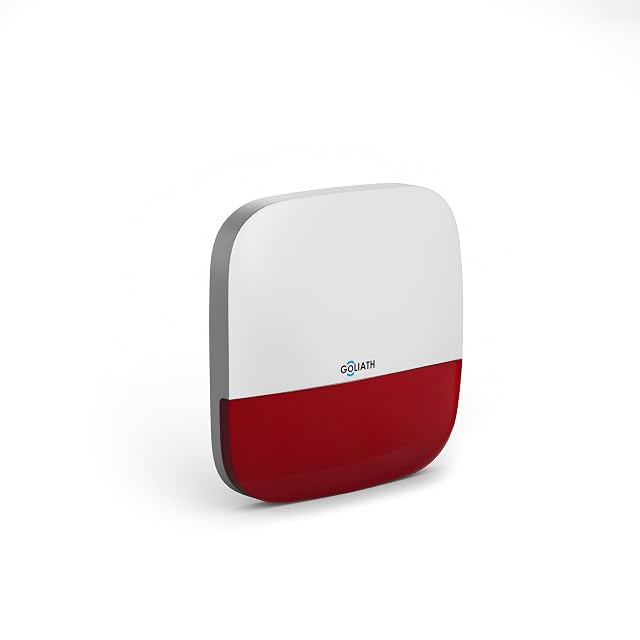
85–110 dB · 868 MHz AirShield, to 1,200 m (4 ft) open field · warning light · burglary, fire and panic tones
The outdoor siren for Goliath's AirShield system: 85 to 110 dB with a warning light, three distinct alarm tones, and 868 MHz radio quoted at up to 1,200 m (4 ft) in open field.
Best for: A Goliath system on a property large enough that the hub and the siren are far apart.
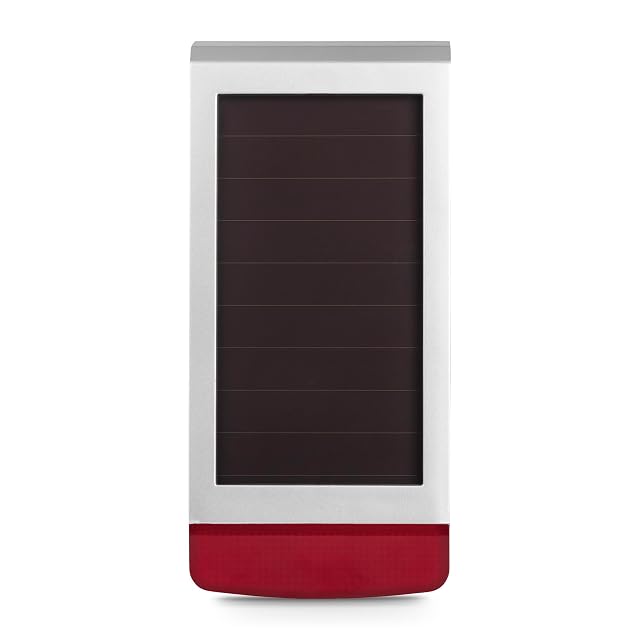
100 dB from two piezo speakers · solar with replaceable NiMH pack · outdoor · needs an Access Point
A solar-powered outdoor siren with two piezo speakers at 100 dB and an optical signal, running on a replaceable NiMH pack charged by its own cell. It requires a Homematic IP Access Point and the app.
Best for: A Homematic IP installation where running a cable to the siren is not practical.
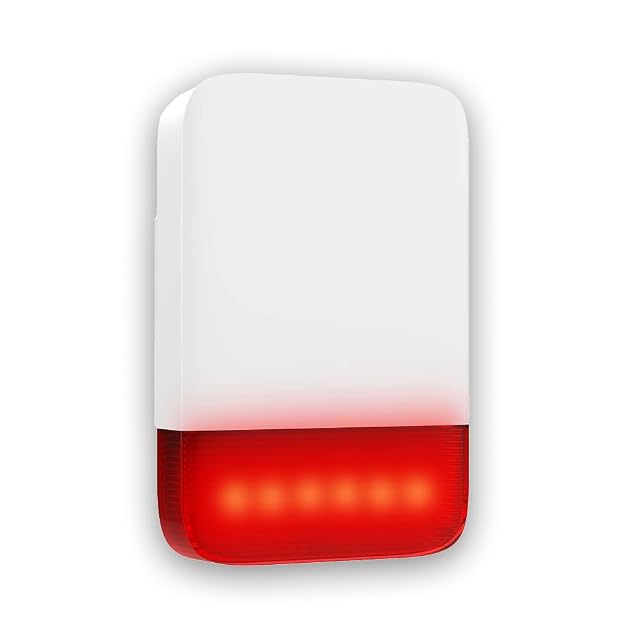
120 dB adjustable · strobe · 5000 mAh backup · 433 MHz to 10 hosts, 80 m (262 ft) · tamper protection
HUXGO's larger outdoor siren: 120 dB with adjustable volume and a strobe, a 5000 mAh backup battery, tamper protection, and pairing with up to ten HUXGO hubs.
Best for: A HUXGO system where the siren must survive a long power cut, or where several hubs share one siren.