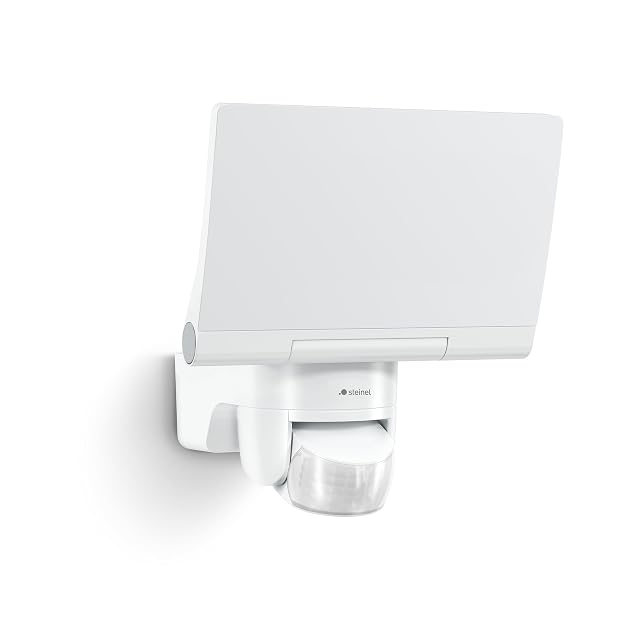
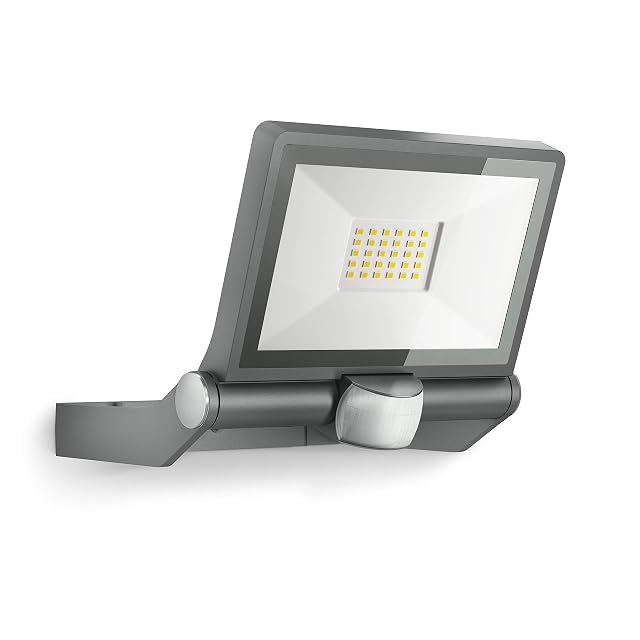
Steinel has made motion sensors for decades, and two things in this catalog show it.
The panel and the sensor aim separately
They want to point in different directions. The beam should cover the approach; the sensor should sit across it, because PIR sensors detect movement crossing their field far better than movement towards it.
On lights where both are fixed to one bracket, one of the two is always compromised. Steinel lets you set each, and both models publish their detection geometry — 180° to 12 m (39 ft) on the XLED ONE S, 180° to 10 m (33 ft) on the XLED Home 2 S.
Warm light, and why it is a security consideration
Both Steinel lights are 3000 K, the only warm lights stated in this hub. On a house wall they look like lights rather than like industrial equipment, which means they stay fitted and the neighbors do not object — and a floodlight that gets disconnected after complaints protects nothing.
The trade is honest: warm light renders less detail for a camera than neutral light does.
Where the money goes
Both are dearer than the unbranded lights, and no brighter: 2,050 lm for the XLED ONE S, level with the 2,000 and 2,200 lm of the Realky and the GRIFEMA, and 1,550 lm for the XLED Home 2 S, the dimmest in the hub. What you buy is precision — panel and sensor each adjustable, a run-on time from 8 s to 35 min — and a finish that suits the front of a house.