No mains, no network, and it runs for a season on AA cells · review
Mucxtaim H3W review
A solar trail camera with a built-in 10,000 mAh rechargeable cell, so it does not run on AA batteries at all. Mucxtaim states 5K video, 64 MP stills, a 120° lens and app transfer over its own Wi-Fi or Bluetooth.
The conclusion The top of this hub and the one you visit least. Choose it for the power system, and only where a visible glow does not matter.
Every other trail camera here runs on AA cells, and the routine that goes with
them: eight batteries, a walk, a strap undone, a re-aim. This one has a solar
panel and a 10,000 mAh cell, and the routine largely disappears.
What the power system actually solves
Between March and October, on a post with sky above it, this camera looks
after itself. That is the whole proposition, and for a location an hour away
it is worth more than any sensor specification.
Winter is where the claim needs qualifying. A panel of this size at a northern
latitude in December, under bare branches, produces a small fraction of its
summer output — and December is when the nights are long and the camera is
awake most. The large internal cell is what carries it: it buys weeks, and it
does not abolish the problem.
The trade an integrated cell makes
You cannot bring a charged set. On an AA camera a dead battery is solved from
a pocket; here it is solved with a power bank and a wait. In exchange there is
nothing to buy and nothing to carry on ordinary visits. Mucxtaim says as much: in prolonged rain, the camera comes down to be charged.
The wavelength, again
850 nm. It reaches further and it glows, faintly and visibly, at night. For
wildlife on open ground that is the right choice. For watching an approach
discreetly, the 940 nm cameras in this hub are.
Who it suits
A remote position with sky above it, visited as rarely as possible.
Availability
Not found on the American Amazon store, where the buy link falls back to a local search rather than to a page that does not exist.
Prices and availability are what Keepa reported on the date this page was updated; both move.
What reassures, and what does not
Strengths
Solar panel and a 10,000 mAh internal cell — no AA batteries to replace
5K video and 64 MP stills from a 5 MP sensor
Trigger stated under 0.1 s
2-inch screen and physical buttons: set up without a phone
Compromises
850 nm illumination glows faintly and is visible at night
Solar output in winter is a fraction of the summer figure
An integrated cell cannot be swapped for a charged one in the field
Wi-Fi and Bluetooth reach about 20 m (65 ft) in the open
Where this model stands apart
Weighed against the median of its own range on this site — not against the security market at large.
Video5K UHD from a 5 MP sensor, 64 MP stills, stated by Mucxtaim25% above the median of this range
Night illumination850 nm infrared10% below the median of this range
Specifications
Video
5K UHD from a 5 MP sensor, 64 MP stills, stated by Mucxtaim
Power
Integrated 10,000 mAh lithium cell, 3.5 W solar panel with a 3 m (10 ft) cable
Lens
120° wide angle
Night illumination
850 nm infrared
Connection
Local Wi-Fi hotspot or Bluetooth, with the TrailCam Go app; about 20 m (65 ft) in the open
Weather rating
IP66, −30 °C (-22 °F) to 70 °C (158 °F) stated
Trigger speed
Under 0.1 s, stated by Mucxtaim
Screen
2 inches, with physical buttons
Supplied
3.5 W solar panel, 32 GB card, strap and two metal mounts
Amazon reference
B0GTZNMNB6
EAN
0751390570719
The questions we are asked
Does solar remove battery worry entirely?
In summer, effectively yes. In December at a northern latitude a small panel produces a fraction of its summer output, and a trail camera under tree cover receives less again. The 10,000 mAh cell is what carries it through — it buys weeks rather than solving winter.
Is an integrated cell better than AAs?
It is more convenient and less flexible. There is nothing to buy and nothing to carry, and there is also no swapping in a charged set when you arrive to find it flat. On AA cameras you can bring eight lithium cells; here you bring a power bank and a cable, or you wait for sun.
Why 850 nm on a camera at this price?
It reaches further for the same power, which suits wildlife and open ground. It also glows faintly, so anybody looking at the camera at night can see it working. For discretion, the 940 nm cameras in this hub are the right choice.
Our score
8.4/ 10
The top of this hub and the one you visit least. Choose it for the power system, and only where a visible glow does not matter.
What this one costs among trail cameras
A reference exists on these Amazon stores: France, Germany, Italy, Spain, United Kingdom. Listed is not the same as in stock — availability changes daily.
Details checked on September 2, 2026.
The buyer this one serves, among security devices
A position visited rarely, where changing batteries is the thing you want to stop doing.
Amazon reports what buyers took in the month before this page was last checked: at least 100.
The figure is a floor, rounded by Amazon, and read through Keepa — it says what buyers picked, not what a maker claims.
Sources
Specifications: the manufacturer sheet for home security products and the matching Amazon product page. Prices and availability: Keepa. Every figure on this page names its source.
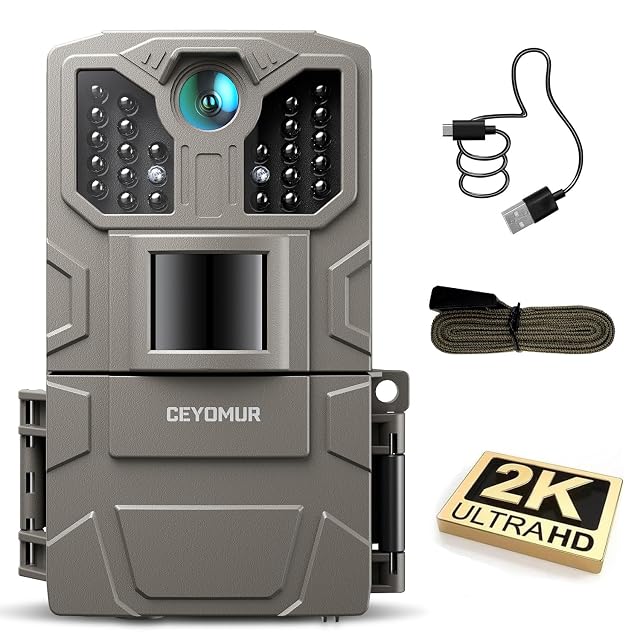
2K video · 24 × 850 nm IR LEDs · IP66 · camouflage housing · keyhole lock point
A camouflaged trail camera with 24 infrared LEDs at 850 nm and a front-opening body. CEYOMUR states 2K video with audio, an IP66 housing and a built-in keyhole for a lock.
Best for: A shed, a gate on a track or a plot with no power, where the camera should not be obvious.
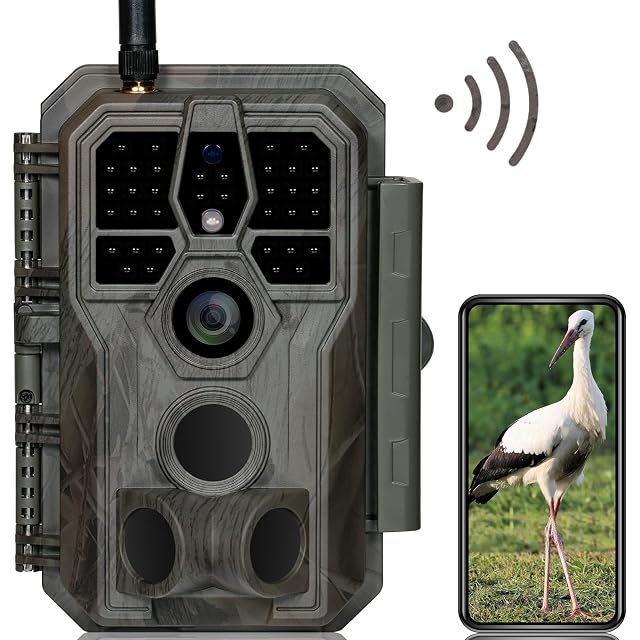
64MP stills · 1296p H.264 video · Bluetooth and Wi-Fi pairing · 36 × 940 nm LEDs · no monthly fee
GardePro pairs by Bluetooth before switching to Wi-Fi, which removes the step where trail-camera apps usually fail. It states 64 MP stills, 1296p H.264 video, 36 no-glow LEDs and an external high-gain antenna, with no subscription.
Best for: Anyone who has already given up on a trail camera app once.
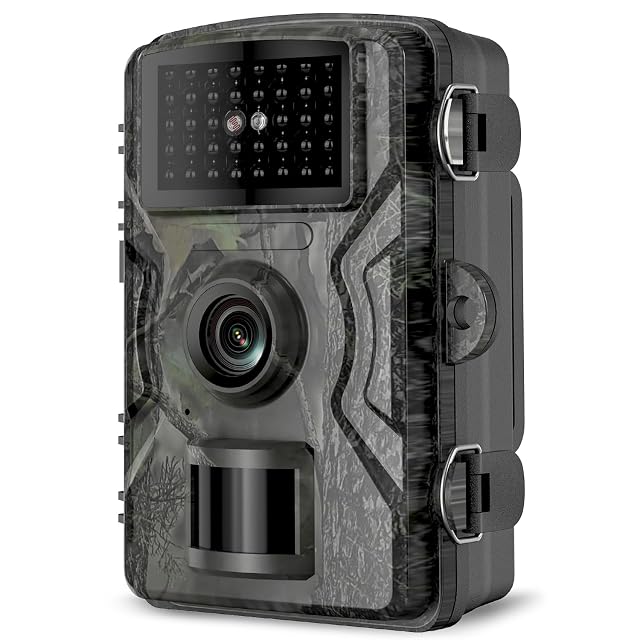
4K · 32MP · 940 nm no-glow to 24 m (79 ft) · 0.1–0.3 s trigger · −29 to 21 °C (-20 to 70 °F) rated · IP66
HSSNS states 4K video, 940 nm no-glow night vision to 24 meters (79 ft), a trigger of 0.1 to 0.3 seconds with three-shot bursts, and operation rated from −29 °C (−20 °F) to 21 °C (70 °F), with a 2.4-inch color screen and password protection.
Best for: A cold, exposed position where the camera has to keep working through a winter.