Skip to content

No mains, no network: five ways to watch anyway

A place with no power removes every wired option and most wireless ones. What remains: a trail camera on AA cells, a solar trail camera you visit rarely, a solar battery camera if there is Wi-Fi within reach, a solar kit with its own recorder if the house is close but its Wi-Fi is not, and a 4G camera if there is not.

The constraint decides the product, and there are only three constraints that matter.

No power, no network, and you visit

A trail camera on AA cells. Use lithium cells rather than alkaline — alkaline loses most of its capacity below freezing, which is why cameras report low battery in November.

No power, no network, and you rarely visit

A solar trail camera with an internal cell. Between March and October it looks after itself; the cell carries it through the winter rather than solving it.

No power, but Wi-Fi reaches

A solar battery camera. Cheaper, and it notifies your phone.

No power, the Wi-Fi does not reach, but the house is close

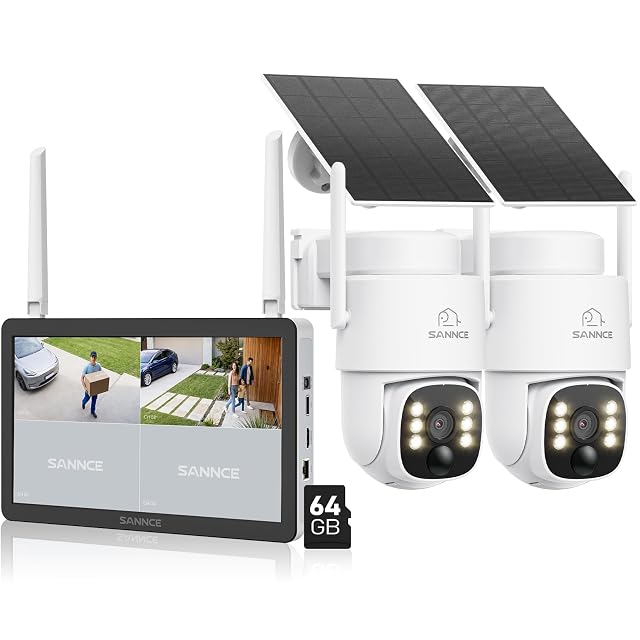
A solar kit with its own recorder, like the SANNCE solar pan-tilt kit. The cameras talk to a recorder with a screen inside the house, not to your router, so the house Wi-Fi does not have to reach the spot — only the recorder’s own radio link does. It records on detection by default; continuous recording can be switched on, at the cost of the battery.

Neither, and you need to know now

A 4G camera with its own SIM. Configure it to record locally and send events rather than to stream — that decision, not the camera, sets the monthly data bill.

What every one of them needs

A cable lock. A camera in a field is small, valuable and unattended.

Which device does your home need?

There is no mains at all
Battery, solar, or both, and an honest assessment of winter daylight.
The spot gets real sun
A solar panel can make the installation self-sufficient for most of the year.
The spot is shaded
Solar will disappoint, and you are back to swapping batteries.
You visit regularly anyway
A trail camera with a card may be all you need.

Picking by what you are protecting

Outbuildings and gates

The classic case. Somewhere worth watching where running a cable is impractical.

Land and paddocks

Where solar is the only realistic power and where mounting is a challenge in itself.

Temporary monitoring

Where a battery camera covers a period without any installation at all.

Winter

Where every solar installation is tested and many are found wanting.

What actually protects, and what is noise

Honest sunlight assessment
A panel needs direct light, not general daylight. South-facing and unshaded is a different proposition from under a tree.
Battery capacity against activity
A busy view drains a battery whatever the panel does. Detection settings matter as much as the power source.
Winter performance
Short days and cold together reduce both generation and capacity. A system that works in June may fail in December.
Ease of battery swapping
Removable batteries make a shaded installation workable. Built-in ones mean taking the camera down each time.
What happens when it dies
A camera that has been flat for two weeks recorded nothing for two weeks, and usually nobody noticed.

Which figure for which entrance

Your positionThe powerThe limit
Open and sunnySolar panelWinter still bites
ShadedBattery swappingA regular chore
Busy viewLarger battery and tight zonesActivity drains fast
Visited oftenA trail cameraNo alerts

Where this is usually botched

Fitting solar in shade
General daylight is not enough. A panel needs direct sun for real hours to keep up with a camera's consumption.
Assuming summer performance lasts
Short winter days and cold batteries together are what defeat solar installations, usually in the month you needed them most.
Not tuning detection
Every event costs power. Narrowing zones and reducing sensitivity extends life more than a bigger panel often does.
Never checking it is alive
An apartment camera fails silently. A periodic check is what stops two weeks of nothing being recorded.

By the home you have

The landowner
Uses solar in an open position and accepts checking on it through winter.
The shaded site owner
Plans around battery swaps and chooses a camera with removable batteries.
The occasional monitor
Uses a trail camera and reads the card on visits, which needs nothing at all.

Batteries, updates and working life

Solar installations need cleaning in a way people forget: a panel filmed with dust, pollen or bird droppings generates a fraction of its rated output. Combined with winter's short days, that is usually what causes a system to fail rather than any fault.

  • Clean the solar panel periodically; output falls dramatically when dirty.
  • Angle the panel for winter sun rather than summer, since that is when it struggles.
  • Check battery health each year; capacity falls with age and cold.
  • Keep a charged spare battery if the position is shaded.

Safety

Remote power installations and height.

  • Mount panels and cameras securely; wind loads on panels are significant.
  • Do not use damaged or swollen batteries.
  • Work safely at height and in poor weather, or wait for better conditions.
  • Secure equipment so the camera and panel are not themselves stolen.

The choices, and what settled them

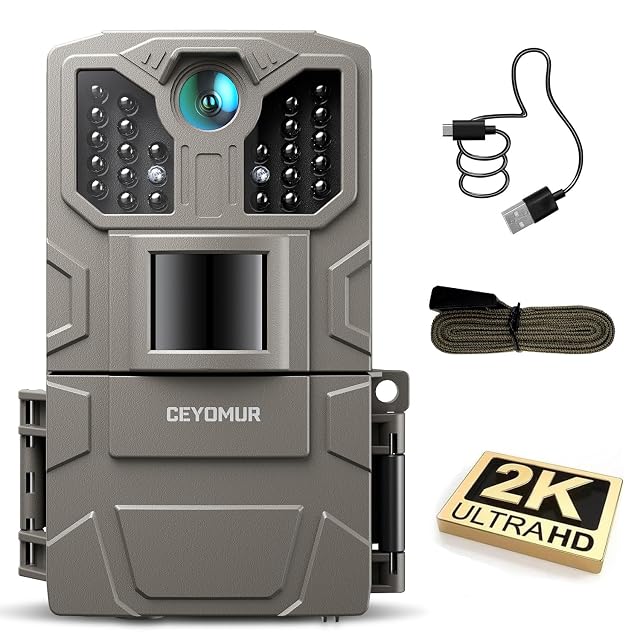
  1. CEYOMUR CY40

    2K video · 24 × 850 nm IR LEDs · IP66 · camouflage housing · keyhole lock point

    A camouflaged trail camera with 24 infrared LEDs at 850 nm and a front-opening body. CEYOMUR states 2K video with audio, an IP66 housing and a built-in keyhole for a lock.

    Best for: A shed, a gate on a track or a plot with no power, where the camera should not be obvious.
    7.2/10

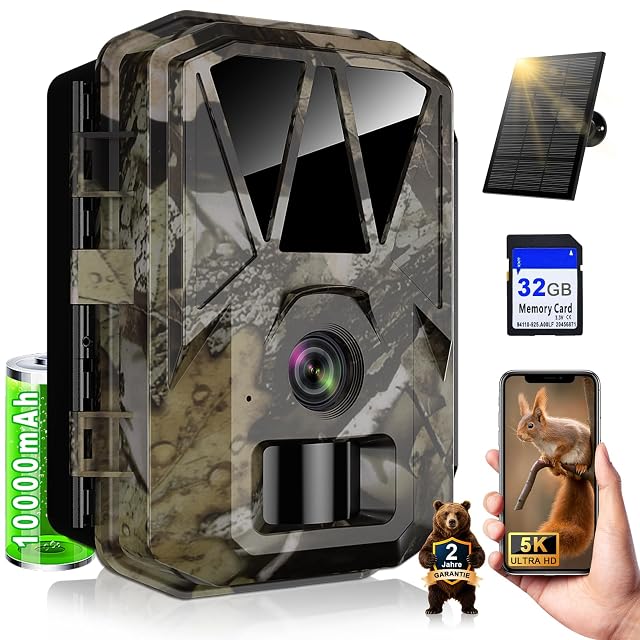
  2. Mucxtaim H3W

    5K · 64MP · solar with 10,000 mAh cell · 120° lens · 850 nm IR · IP66

    A solar trail camera with a built-in 10,000 mAh rechargeable cell, so it does not run on AA batteries at all. Mucxtaim states 5K video, 64 MP stills, a 120° lens and app transfer over its own Wi-Fi or Bluetooth.

    Best for: A position visited rarely, where changing batteries is the thing you want to stop doing.

    8.4/10

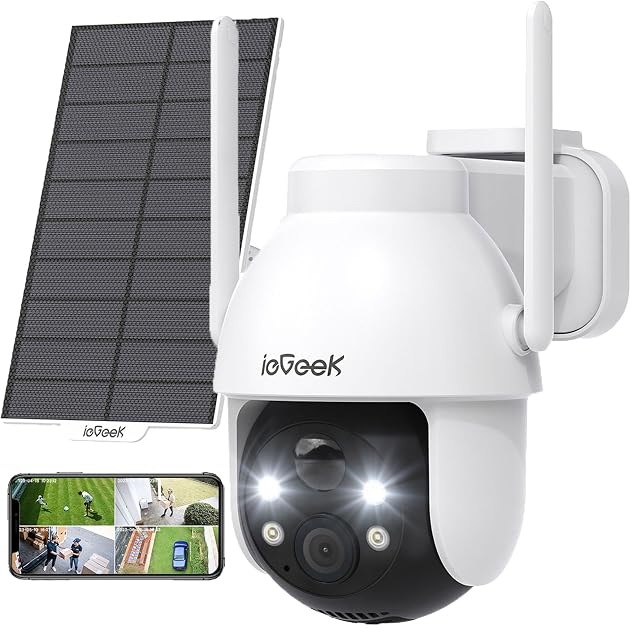
  3. ieGeek ZY-C2

    2K 3MP · solar · 355° × 120° PTZ · color night vision to 15 m (49 ft) · card to 128 GB · IP65

    A fully wireless solar pan-and-tilt camera with a 130° lens, 2K capture and color night vision stated to 15 m (49 ft). ieGeek supplies warning stickers with it, which is a small detail that says something about how it expects to be used.

    Best for: A garden or driveway with sun, where the camera should also be seen to be there.

    7.8/10

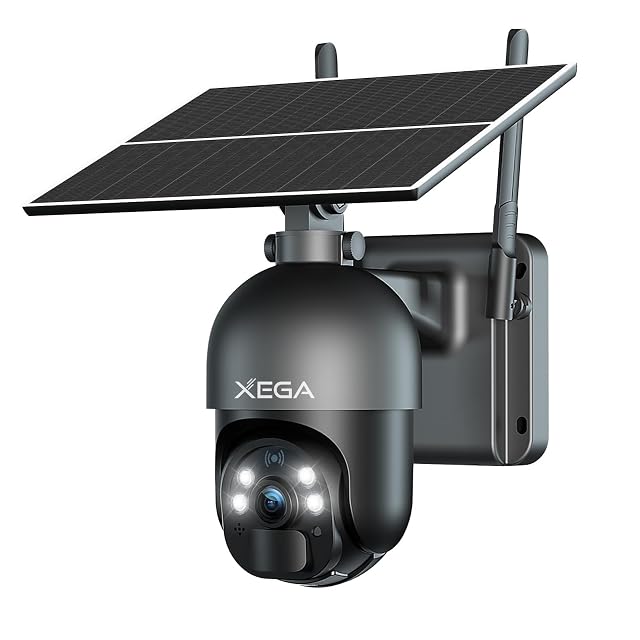
  4. Xega S20

    4G LTE with SIM · 10,400 mAh battery · solar · 355° pan, 95° tilt · PIR · no Wi-Fi needed

    The camera for a place with no network at all. Xega states 4G LTE with a SIM card supplied, a 10,400 mAh battery, solar charging and 355° coverage, with two night-vision modes and PIR detection.

    Best for: An allotment, a barn, a building plot or a second property — anywhere with no Wi-Fi to join.

    7.8/10

    ≈ $60

The questions we are asked

What is trigger speed and why does it matter?

The delay between the sensor detecting warmth and the shutter firing. A walking person covers about 1.4 m (4.6 ft) a second: at 0.2 seconds they have moved around 30 cm (1 ft); at one second, nearly a meter and a half (5 ft), and possibly out of frame. It is a deciding figure for a trail camera and often missing from listings: here, the Mucxtaim H3W states under 0.1 s, the CEYOMUR CY40 does not publish one.

Do I need 4G or is Wi-Fi enough?

Stand at the site with a phone and look. If your house Wi-Fi reaches, a solar battery camera is simpler and cheaper. If it does not, a 4G camera with its own SIM is the only option that reports anything remotely.

Will a solar panel keep a camera running all year?

In an open, sunny position often yes for most of the year, but winter is the test. Short days and cold batteries defeat many installations.

How much sun does a panel need?

Direct sunlight for real hours, not general daylight. A panel under a tree or on a north-facing wall will not keep up.

What drains the battery fastest?

Motion events and infrared at night. Narrowing detection zones extends life more effectively than most people expect.

Is a trail camera an option?

If you can visit to read the card and do not need alerts, it is often the simplest and cheapest answer by a wide margin.

Why does my camera die every winter?

Cold reduces battery capacity and short days reduce generation, at the same time. It is the normal failure mode of solar installations.

Can I use a car battery?

People do, but it needs a suitable charge controller and safe housing. It is a project rather than a purchase, and safety matters.

Each device, and the door it watches

CEYOMUR CY40

Designed for: A shed, a gate on a track or a plot with no power, where the camera should not be obvious.
Its main asset: Camouflage housing that genuinely disappears against bark and hedge

Its main gap: 850 nm LEDs emit a faint visible red glow — they are not invisible

Read the full review →

Mucxtaim H3W

Designed for: A position visited rarely, where changing batteries is the thing you want to stop doing.

Its main asset: Solar panel and a 10,000 mAh internal cell — no AA batteries to replace

Its main gap: 850 nm illumination glows faintly and is visible at night

Read the full review →

ieGeek ZY-C2

Designed for: A garden or driveway with sun, where the camera should also be seen to be there.

Its main asset: Solar panel with a fully wireless installation

Its main gap: Card ceiling of 128 GB

Read the full review →

SANNCE Solar PT Wireless Camera Kit

Designed for: A plot, outbuilding or gate where running power to a camera would cost more than the kit.

Its main asset: No power or network cable to run to either camera: battery plus solar panel

Its main gap: Continuous recording can be switched on, but on battery and solar it cannot be guaranteed day and night

Read the full review →

Xega S20 · $60

Designed for: An allotment, a barn, a building plot or a second property — anywhere with no Wi-Fi to join.

Its main asset: Works with no Wi-Fi at all: 4G LTE with a SIM supplied

Its main gap: A SIM means a data plan, and the trial one runs for seven days

Read the full review →

What to add to it

Accessories and spares from the same aisle, at the price we read. Confirm they suit the device you choose before ordering: it turns on the model and the part number, which the listing gives.

The short decision

Comparisons that matter here

Device against device, already covered, inside this guide or this aisle.

What this comparison is built on

The devices listed are drawn from the catalog of this site. Specifications are those the maker and the Amazon listing publish; prices are what Keepa recorded on the date shown, and both move. The order follows declared specifications, the balance between stated strengths and stated limits, and price. No device here has been installed or tested by us, and no page claims it was.

Last checked on

Prices quoted in these summaries are dated readings. The live price is shown next to each product.

The tool we use ourselves

Chosen your tool? Now buy it at the right price.

Cameras, alarm kits and safes swing by thirty dollars or more across the year, and the biggest "discounts" often land at prices the same model sold for six weeks earlier. UniverTrack tracks the real price history across retailers, spots fake reductions, and alerts you when it is genuinely the moment to buy.

Real price historyBuy-now alertsAI buying assistant
Try free for 14 days →
No commitment · Cancel in one click · 5 languages