Skip to content

Letting somebody in: four key safes and where to put one

A key safe solves a real problem and creates a smaller one: the key to the house is now outside it. Two things decide whether that is sound — where it is fixed, and how often the code changes. The box itself matters least.

The box is the least important part of this purchase.

Placement

Out of sight of the pavement, on a different elevation from the door it opens, at a height that is not obvious. The ten seconds somebody spends looking for a key safe is time nobody spends if it is round the side.

Fixing

Through-bolted into solid masonry. A key safe on render, on a timber frame or on a fence post leaves with what it is attached to, and the code becomes irrelevant.

The code

Four digits, changed twice a year and whenever the list of people changes. Scramble the dials after every closing: a box left on the right code opens without knowing it.

Capacity

Measure the key first. Most small boxes take a key up to 7 cm (2.8 in) — which excludes long security keys and anything on a fob.

What a key safe is not

A safe. It resists a hand and a screwdriver, not tools.

Which device does your home need?

A carer needs regular access
A key safe is the usual solution, and the model and placement both matter.
You want it approved
None of the four in this guide states an independent test: ask the insurer or the care provider what they require before buying.
It will be by the front door
Placement out of obvious view matters, since a visible key safe advertises itself.
You are insured
Check the policy, because some insurers have views on key safes.

Picking by what you are protecting

Care visits

The main reason. Multiple carers needing access without carrying keys.

Emergency access

Where emergency services or family may need to get in quickly.

Cleaners and trades

Where the same convenience applies and the same risks do too.

Vacation rentals

A different use with different security considerations, since the code circulates widely.

What actually protects, and what is noise

Independent testing
Key safes vary enormously in how much attack they resist. Independently tested models exist and are what care providers and insurers reference.
Mounting
Into masonry with the fixings supplied, not into stucco or mortar joints. The fixing is as important as the safe.
Placement
Out of the obvious line of sight. A key safe beside the door is a sign that a key is present.
Code management
Who knows the code and how often it changes. A code known to a dozen former carers is not a code.
What your insurer says
Policies differ, and some have specific wording about keys held outside the property.

Which figure for which entrance

Your situationWhat mattersThe note
Regular carersAn approved key safeProviders often specify one
Any installationMounting into solid masonryThe fixing is the weak point
PlacementOut of obvious viewA visible safe advertises a key
OngoingChanging the codeOld carers keep old codes

Where this is usually botched

Thinking the box is the security
Cheap models give way quickly to tools, and none in this guide states an independent test: fixing into masonry and code discipline decide.
Mounting into stucco or mortar
The safe comes off the wall with the key still in it. Fixing into solid masonry is the whole basis of it working.
Never changing the code
Every carer, cleaner and tradesperson who has ever used it still knows it. Periodic changes are part of using one.
Putting it in plain sight beside the door
It announces that a key is available. Somewhere less obvious is meaningfully better.

By the home you have

The family arranging care
Needs an approved model, mounted properly, with a code they manage.
The person receiving care
Needs something they can operate too, and placement that suits them.
The insured householder
Should check the policy wording, since insurers differ on keys held outside.

Batteries, updates and working life

Key safes live outdoors and seize, and a key safe that will not open is a carer standing outside. Mechanisms corrode, buttons stick and the fixings loosen in freeze-thaw cycles, all of which develop slowly and unnoticed.

  • Operate and lubricate the mechanism periodically with a suitable product.
  • Check the fixings remain tight; freeze-thaw loosens masonry fixings over years.
  • Keep the cover closed so water does not sit in the mechanism.
  • Change the code on a schedule and tell current carers, not former ones.

Safety

A key outside the house is a considered risk.

  • Fix it into solid masonry: a box pried off makes the code irrelevant.
  • Change the code whenever someone no longer needs access.
  • Check whether your insurer accepts a key safe and under what conditions.
  • Do not use a key safe for a property that stands empty for long periods.

The choices, and what settled them

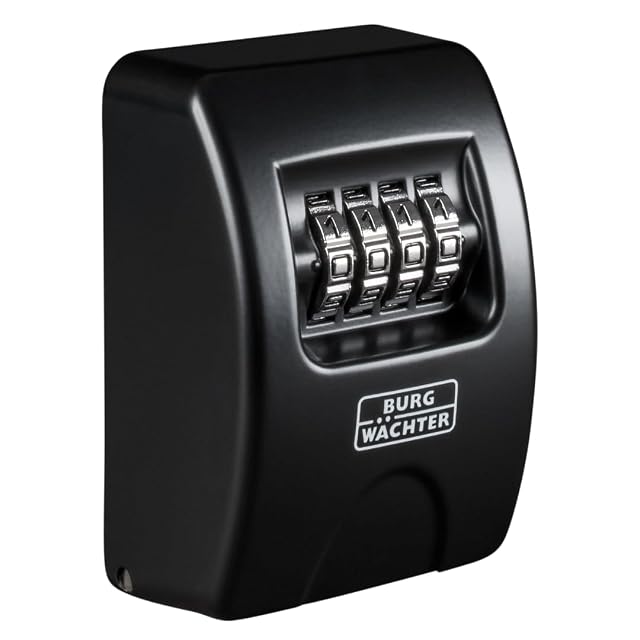
  1. BURG-WÄCHTER Key Safe 10 SB

    Wall-mounted · zinc die-cast · 4-digit code · internal hook · keys to 7 cm (2.8 in) · auto-stop

    A wall-mounted key safe in zinc die-cast with an internal hook for keys up to 7 cm (2.8 in), a four-digit resettable code and an auto-stop feature, from a German safe manufacturer.

    Best for: A permanent installation on masonry, where the maker's other business is actually safes.

    7.8/10

    ≈ $46

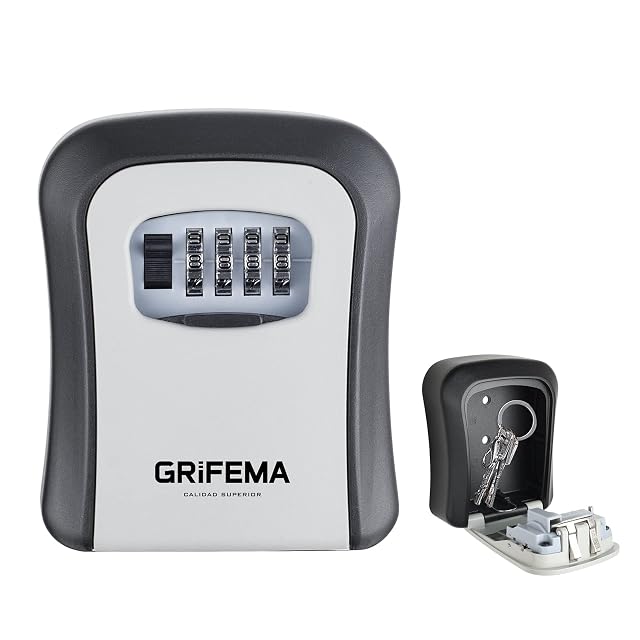
  2. GRIFEMA GA1003

    Wall-mounted · 4-digit code, 10,000 combinations · zinc alloy, 227 g (8 oz) · weather and frost resistant

    A small wall-mounted key safe in zinc alloy with a four-digit code. GRIFEMA states 10,000 combinations, weather and frost resistance, and a body designed to resist hammering and sawing.

    Best for: A single spare key for a carer, a cleaner or a household that locks itself out.

    7.2/10

    ≈ $44

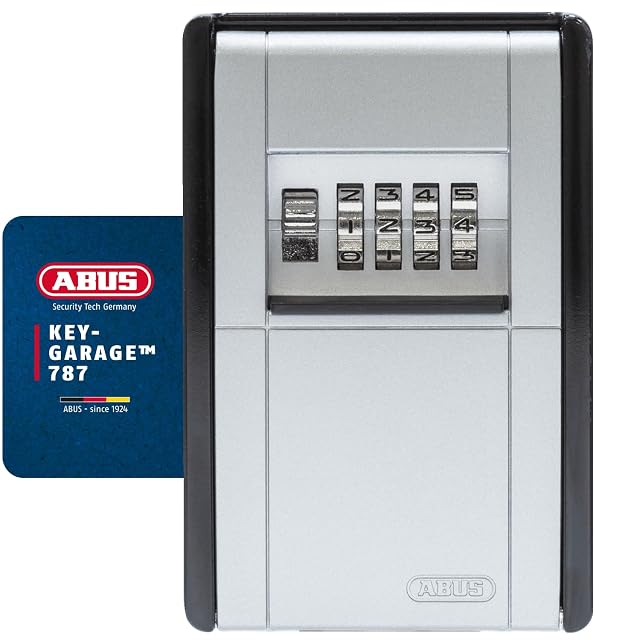
  3. ABUS KeyGarage 787

    Wall-mounted · holds 20 keys or 14 cards · steel housing, zinc dial flap · 689 g (24.3 oz) · sliding cover

    With its white version, the largest key box in this hub: ABUS states room for twenty keys or fourteen plastic cards, in a steel housing with a zinc die-cast dial flap, a sliding protective cover and a removable rack. 689 grams.

    Best for: A building with several keys and several people — a vacation rental, a small business, a shared house.

    7.8/10

    ≈ $38

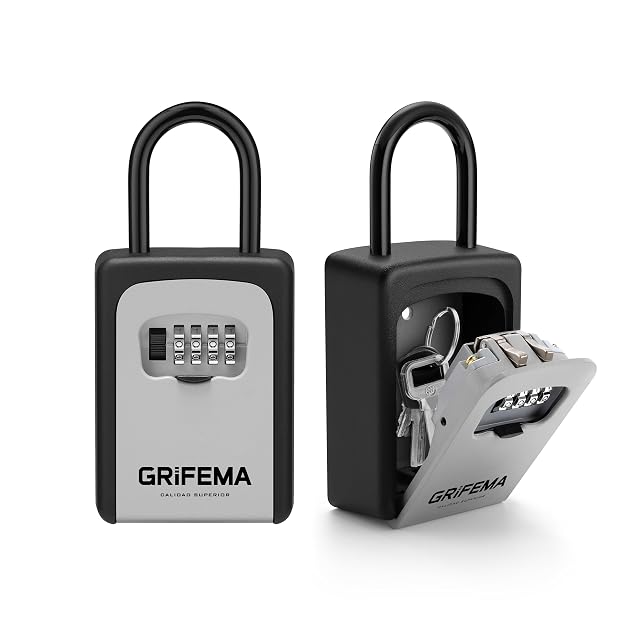
  4. GRIFEMA GA1004

    Shackle-mounted · holds 5 keys and a card · 4-digit code · zinc alloy, 558 g (19.7 oz) · removable key rack

    The hanging version of GRIFEMA's key safe: a shackle rather than a wall plate, room for five keys and a card, and a removable key rack. 558 grams of zinc alloy with a four-digit code.

    Best for: A rental property, a temporary arrangement, or a door handle where nothing may be drilled.

    7.8/10

    ≈ $45

The questions we are asked

Where should a key safe go?

Out of sight of the street, not beside the door it opens, and bolted through into solid masonry. A key safe next to the front door tells a passer-by exactly what it contains and which door it serves.

How often should the code change?

Twice a year, and whenever somebody stops needing access. On a dial box, like the GRIFEMA GA1003 or the ABUS, scramble the dials after every closing: a box left on the right code opens without knowing it.

Are key safes secure?

They resist a hand and a screwdriver, not tools. None of the four in this guide states an independent test: fixing into solid masonry and code discipline matter more than the model.

Will my insurer accept one?

Policies differ and some have specific wording about keys kept outside. Ask before fitting rather than at claim time.

Can I use one for a vacation rental?

People do, but the code circulates far more widely, and that changes the risk considerably compared with a care arrangement.

What if it seizes?

It happens, and it leaves a carer outside. Periodic operation and lubrication with a suitable product is what prevents it.

Who should know the code?

Only the people who currently need access. Every former carer, cleaner and contractor who has ever used it is a reason to change it.

Each device, and the door it watches

BURG-WÄCHTER Key Safe 10 SB · $46

Designed for: A permanent installation on masonry, where the maker's other business is actually safes.

Its main asset: From a manufacturer whose main business is safes rather than accessories

Its main gap: 7 cm (2.8 in) is a real limit — long keys and fobs will not fit

Read the full review →

GRIFEMA GA1003 · $44

Designed for: A single spare key for a carer, a cleaner or a household that locks itself out.

Its main asset: Four digits rather than three — ten thousand combinations instead of a thousand

Its main gap: 227 g (8 oz) of zinc alloy is not a safe — it resists opportunists, not tools

Read the full review →

ABUS KeyGarage 787 · $38

Designed for: A building with several keys and several people — a vacation rental, a small business, a shared house.

Its main asset: Twenty keys or fourteen cards — only its white version holds as many here

Its main gap: 689 g (24.3 oz) and 84 × 120 × 44 mm (3.31 × 4.72 × 1.73 in) — it is not discreet

Read the full review →

GRIFEMA GA1004 · $45

Designed for: A rental property, a temporary arrangement, or a door handle where nothing may be drilled.

Its main asset: Hangs on a handle, railing or gate — no drilling at all

Its main gap: A hanging box can be carried away and opened elsewhere, at leisure

Read the full review →

The short decision

Comparisons that matter here

Device against device, already covered, inside this guide or this aisle.

What this comparison is built on

The devices listed are drawn from the catalog of this site. Specifications are those the maker and the Amazon listing publish; prices are what Keepa recorded on the date shown, and both move. The order follows declared specifications, the balance between stated strengths and stated limits, and price. No device here has been installed or tested by us, and no page claims it was.

Last checked on

Prices quoted in these summaries are dated readings. The live price is shown next to each product.

The tool we use ourselves

Chosen your tool? Now buy it at the right price.

Cameras, alarm kits and safes swing by thirty dollars or more across the year, and the biggest "discounts" often land at prices the same model sold for six weeks earlier. UniverTrack tracks the real price history across retailers, spots fake reductions, and alerts you when it is genuinely the moment to buy.

Real price historyBuy-now alertsAI buying assistant
Try free for 14 days →
No commitment · Cancel in one click · 5 languages