Skip to content

Driveway cameras: four that show which car, and who

A driveway asks the two hardest questions in this catalog: which car, and which person, at distance and usually in the dark. Resolution alone does not answer either. Optical zoom moves glass and gathers more light from a narrower angle; digital zoom enlarges what was already recorded. Here, only the Reolink E1 Outdoor Pro has an optical zoom (3×); the TrackMix adds a telephoto lens to its wide angle; the Tapo C530WS and the 4K kit have none and rely on resolution.

Distance is what makes a driveway hard, and distance is where resolution stops being the answer.

Why 4K alone is not enough

A 4K sensor spread across a wide scene still gives you a small, soft face at forty meters. Optical zoom concentrates the same sensor on a narrower angle, which is how the detail appears.

The night half of the problem

Color at night needs light, and light means the camera announces itself. Infrared is discreet and monochrome. On a driveway, color usually wins — a description of a coat is worth more than an unnoticed camera.

Where to mount

Under an eave, angled down at the approach, so faces are in frame rather than hairlines. Not high on open wall, where rain sits on the lens and the angle looks at the tops of heads.

The one setting to change

Auto-tracking leaves a camera pointed wherever the last movement ended. Set a home position over the gate.

Which device does your home need?

You want to read license plates
A dedicated camera at a chokepoint, not a wide view of the whole drive.
You want general awareness
A wide camera covering the drive, which will not identify anyone at distance.
Your drive faces a road
Expect constant motion events unless detection zones are set carefully.
You have gates
The gate is the chokepoint, and that is where identification is realistically possible.

Picking by what you are protecting

General coverage

Where a wide view shows what happened, without identifying anyone at the far end.

License plate capture

Where a narrow view at a chokepoint, at the right height, is the only thing that works.

Vehicle security

Where the camera is one layer and physical deterrents are another.

Deliveries

Where a camera covering the approach helps, and a doorbell camera does the rest.

What actually protects, and what is noise

The chokepoint
Somewhere every vehicle passes slowly and close. Identification is possible there and almost nowhere else on a drive.
Field of view against detail
The wider the lens, the less detail at distance. A wide camera and a narrow one do different jobs.
Detection zones
A drive open to a road generates constant events. Zones are what make notifications usable rather than ignorable.
Night performance
Headlights blow out an image and plates are reflective. Plate capture at night is genuinely difficult without a dedicated setup.
Mounting height and angle
Too high and you see roofs. Plate and face height at the chokepoint is what produces useful footage.

Which figure for which entrance

What you wantCamera placementThe reality
See what happenedWide view of the driveNobody identifiable at distance
Read a plateNarrow view at a chokepointHeight and angle are critical
Fewer alertsCareful detection zonesA roadside drive is noisy
Night captureLighting plus the cameraHeadlights are the problem

Where this is usually botched

Using one wide camera for everything
It shows the event and identifies nobody. A wide view and a chokepoint camera together are what work.
Mounting too high
A camera under the eaves sees car roofs and the tops of heads. Lower and angled at the chokepoint is what identifies.
Leaving detection wide open
A drive facing a road produces an event per passing car. Nobody reads those notifications after the first week.
Expecting plates at night without lighting
Headlights overwhelm the sensor and plates reflect infrared. Dedicated plate capture is its own discipline.

By the home you have

The owner with gates
Has a natural chokepoint and should put the identifying camera there.
The open-drive owner
Needs careful detection zones or the alerts become useless.
The vehicle-focused owner
Combines a camera with physical security, since a camera records a theft it cannot prevent.

Batteries, updates and working life

Driveway cameras collect road film and salt spray, and both cut night performance long before they affect the daytime picture. A camera that has gone hazy at night is nearly always dirty rather than failing.

  • Clean the lens regularly, particularly if the drive is near a road.
  • Recheck the aim after storms; mounts shift more than people expect.
  • Trim vegetation growing into the view or the infrared beam.
  • Review detection zones seasonally, since foliage changes the scene.

Safety

Driveway cameras usually see the street too.

  • Check what your country requires when a camera captures public space or a neighbor's property.
  • Aim to cover your own drive rather than the sidewalk beyond it.
  • Change default passwords on any connected camera.
  • Do not confront anyone based on footage; give it to the police.

The choices, and what settled them

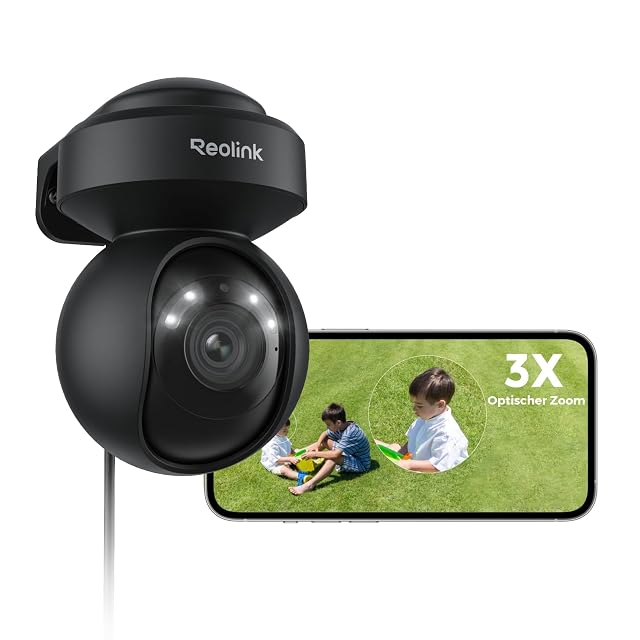
  1. Reolink E1 Outdoor Pro

    4K UHD · 3× optical zoom · dual-band Wi-Fi 6 · 355° pan, 50° tilt · 24/7 recording

    Reolink states 4K with color night images, a genuine three-times optical zoom, dual-band Wi-Fi 6 and auto-tracking across a 355° sweep, with custom detection zones and continuous recording.

    Best for: A property where a face or a license plate at distance actually has to be readable.
    7.8/10

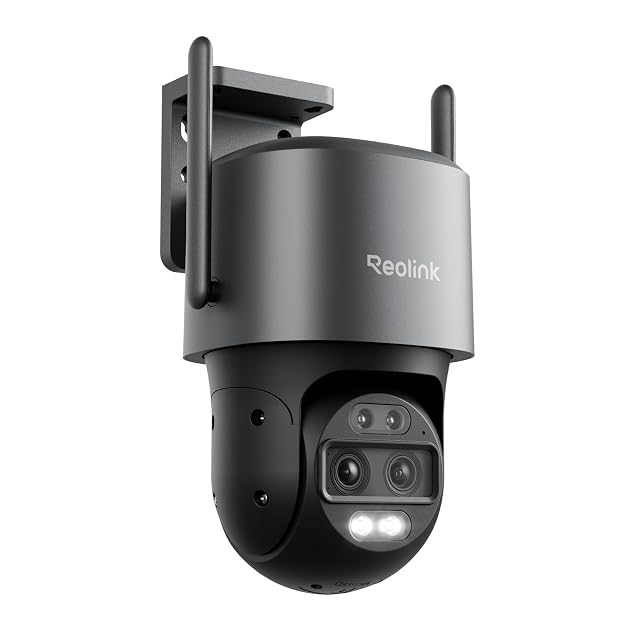
  2. Reolink TrackMix WiFi

    4K · dual lens, wide and telephoto · 6× hybrid zoom · auto-tracking · Wi-Fi 6

    Two lenses in one housing — a wide one that keeps the whole scene and a telephoto one that follows a subject — combined into a single tracked image. Reolink states 4K full color day and night, dual-band Wi-Fi 6 and storage to card, FTP or its own hub.

    Best for: The one camera on a property that has to both watch everything and identify somebody.

    8.4/10

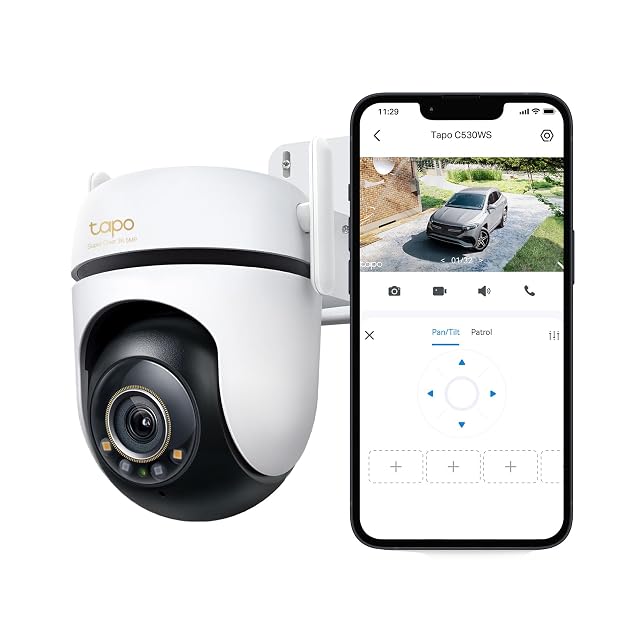
  3. Tapo C530WS

    3K 5MP · Starlight color night vision · 360° with patrol mode · Wi-Fi or Ethernet

    A 2880 × 1620 sensor with a Starlight low-light stack, a full 360° sweep with a patrol mode, tamper and line-crossing detection, and the option of an Ethernet cable instead of Wi-Fi.

    Best for: A property where one motorized camera has to do the work of three fixed ones, on a network that can take a cable.

    7.8/10

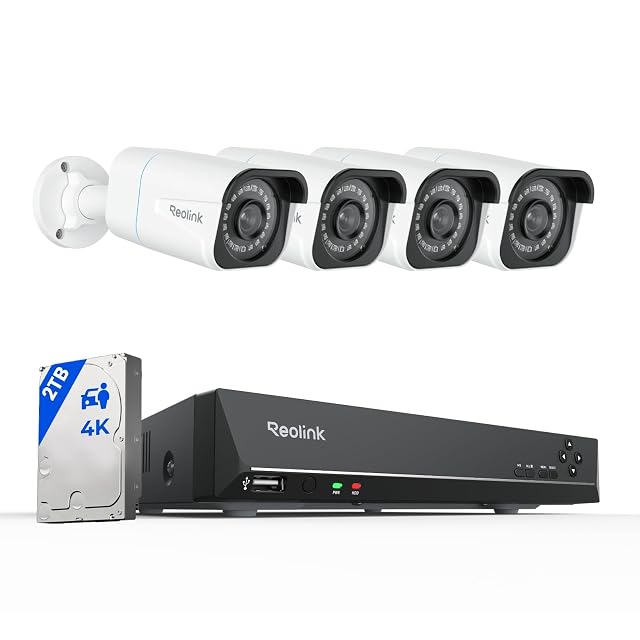
  4. Reolink RLK8-800B4

    4× 4K bullets · 8CH NVR with 2 TB · person and vehicle detection · 24/7

    The 4K version of Reolink's wired kit: four 8 MP bullet cameras at 20 fps, an eight-channel recorder with a 2 TB drive pre-installed, and detection that filters branches and insects out of the alerts.

    Best for: A property where footage may have to be handed to somebody else, and detail decides whether it is any use.

    8.4/10

The questions we are asked

Will any camera read a license plate at night?

Only in specific conditions, and none of these will do it reliably at speed. Headlights blow out a plate, angles matter enormously, and cameras sold for that job are a different and more expensive category. What these do is show which car, which is usually the question people actually have.

Optical or digital zoom?

Optical, without hesitation. Digital zoom enlarges pixels that were already captured and adds nothing; optical moves glass and gathers more light from a smaller part of the scene. On a driveway it is the difference between a face and a shape.

Why do I get so many alerts?

A drive open to a road records every passing vehicle. Detection zones are the fix, and without them notifications become noise.

How high should I mount it?

Low enough to capture faces and plates, high enough not to be easily reached. Under the eaves is usually too high to identify anyone.

Will it work at night?

For seeing movement, yes. For reading a plate, headlights and reflective plates make it genuinely difficult without a dedicated setup.

One camera or two?

Two often works better: a wide view for context and a narrow one at the chokepoint for identification. They are different jobs.

Does a camera protect my car?

It records rather than prevents. Physical security and lighting do the preventing, and the camera helps afterwards.

Each device, and the door it watches

Reolink E1 Outdoor Pro

Designed for: A property where a face or a license plate at distance actually has to be readable.
Its main asset: 3× optical zoom — glass, not pixels, which is the difference that matters

Its main gap: Tilt of 50° is shallower than the 90° or 130° of cheaper cameras

Read the full review →

Reolink TrackMix WiFi

Designed for: The one camera on a property that has to both watch everything and identify somebody.

Its main asset: Two lenses: the wide one keeps context while the telephoto follows the subject

Its main gap: The most expensive camera in this hub, above the Reolink E1 Outdoor Pro

Read the full review →

Tapo C530WS

Designed for: A property where one motorized camera has to do the work of three fixed ones, on a network that can take a cable.

Its main asset: 3K (5 MP) — sharper than anything else in this hub short of the 4K models

Its main gap: Wi-Fi is 2.4 GHz only — the wired option is how you escape that

Read the full review →

Reolink RLK8-800B4

Designed for: A property where footage may have to be handed to somebody else, and detail decides whether it is any use.

Its main asset: 4K bullets — nearly four times the detail of 1080p, stated by Reolink

Its main gap: 4K continuous recording turns 2 TB into days rather than weeks

Read the full review →

What to add to it

Accessories and spares from the same aisle, at the price we read. Confirm they suit the device you choose before ordering: it turns on the model and the part number, which the listing gives.

The short decision

Comparisons that matter here

Device against device, already covered, inside this guide or this aisle.

What this comparison is built on

The devices listed are drawn from the catalog of this site. Specifications are those the maker and the Amazon listing publish; prices are what Keepa recorded on the date shown, and both move. The order follows declared specifications, the balance between stated strengths and stated limits, and price. No device here has been installed or tested by us, and no page claims it was.

Last checked on

Prices quoted in these summaries are dated readings. The live price is shown next to each product.

The tool we use ourselves

Chosen your tool? Now buy it at the right price.

Cameras, alarm kits and safes swing by thirty dollars or more across the year, and the biggest "discounts" often land at prices the same model sold for six weeks earlier. UniverTrack tracks the real price history across retailers, spots fake reductions, and alerts you when it is genuinely the moment to buy.

Real price historyBuy-now alertsAI buying assistant
Try free for 14 days →
No commitment · Cancel in one click · 5 languages