Skip to content

After dark: four cameras and what makes their image

Resolution describes daylight. After dark the image is made by the illuminator: infrared, which gives a monochrome picture and stays invisible, or a white spotlight, which keeps color and announces the camera. There is no version of this trade where you get both.

Every camera in this catalog looks the same in daylight. The differences are all after dark.

Two ways to make an image

Infrared LEDs, which the eye cannot see, producing a monochrome picture. Or white light, which produces color and makes the camera obvious.

Cameras that claim color at night are cameras that light the scene.

The middle ground

A sensitive sensor with a wide aperture gathers more of whatever light already exists — street lighting, a porch lamp, moonlight. Where there is some ambient light, that produces color without the camera announcing itself. Where there is none, it does not.

Published distances

A few cameras state how far their color night vision reaches — 15 m (49 ft), 30 m (98 ft) — after which the image reverts to infrared. Those figures are worth more than an unqualified claim.

The mundane thing that ruins night images

Insects on the lens, lit by the camera’s own infrared. Mount under an eave.

Which device does your home need?

You want to identify faces at night
That is far harder than it sounds, and lighting matters more than the camera.
You want to see movement at night
Infrared does that well and is standard on most outdoor cameras.
You want color at night
That needs either a spotlight or a low-light color sensor, and both have trade-offs.
You have a glass window in the way
Infrared reflects off glass, and the camera sees its own light rather than the scene.

Picking by what you are protecting

Detecting movement

Where infrared is entirely adequate and where most cameras perform acceptably.

Identifying people

Where the difficulty lies, and where camera position and lighting matter far more than the specification.

Color at night

Where a spotlight gives color and also announces the camera, which some owners want and others do not.

Wildlife and driveways

Where infrared range and the width of the view decide whether anything useful is captured.

What actually protects, and what is noise

Infrared range in reality
Stated ranges assume ideal conditions. What matters is whether the subject is lit at the distance you actually care about.
Camera position
A camera at head height a few meters away identifies people. One under the eaves looking down at a hood does not.
Existing lighting
A well-lit approach does more for night footage than any camera upgrade. Lighting is the cheaper improvement.
Spotlight or infrared
A spotlight gives color and deters; infrared is discreet. They suit different purposes and some cameras do both.
Glass and reflections
Any camera behind glass will struggle at night. Mounting outdoors, or disabling infrared and lighting the scene, is the fix.

Which figure for which entrance

What you wantWhat it needsThe catch
See movementOrdinary infraredLittle
Identify a faceClose mounting and lightHarder than expected
Color at nightA spotlight or low-light sensorThe light is visible
Through a windowCamera outdoors insteadInfrared reflects off glass

Where this is usually botched

Mounting too high
A camera under the eaves sees the top of a head. Face height at a chokepoint is what produces identifiable footage.
Filming through glass at night
Infrared bounces off the window and washes the image out. Either mount outside or turn infrared off and light the room's exterior.
Expecting a wide view to identify anyone
The wider the view, the fewer pixels on any face. A narrow view at a chokepoint is what identification actually needs.
Ignoring lighting
A lit approach improves footage more cheaply than any camera. Cameras are not a substitute for light.

By the home you have

The driveway owner
Wants a camera positioned to read a plate at a chokepoint rather than a wide view of everything.
The front door owner
Wants face height coverage close to the door, where identification is realistically possible.
The discreet owner
Prefers infrared over spotlights, accepting monochrome footage in exchange for not announcing the camera.

Batteries, updates and working life

Night performance degrades first, and it degrades from dirt rather than age. A film of salt or dust on the lens scatters infrared straight back into the sensor, producing a white haze that looks like a camera fault.

  • Clean lenses regularly; night footage suffers from dirt long before daytime footage does.
  • Clear cobwebs, which glow brightly under infrared and trigger endless events.
  • Check the infrared cut filter still switches; a stuck filter ruins day or night images.
  • Trim vegetation that has grown into the infrared beam and reflects it back.

Safety

Lighting and cameras affect other people too.

  • Aim spotlights so they do not shine into neighbors' windows.
  • Check the legal position on cameras that see beyond your property, particularly at night when few people notice.
  • Change default passwords on any connected camera.
  • Work safely at height when mounting or cleaning.

The choices, and what settled them

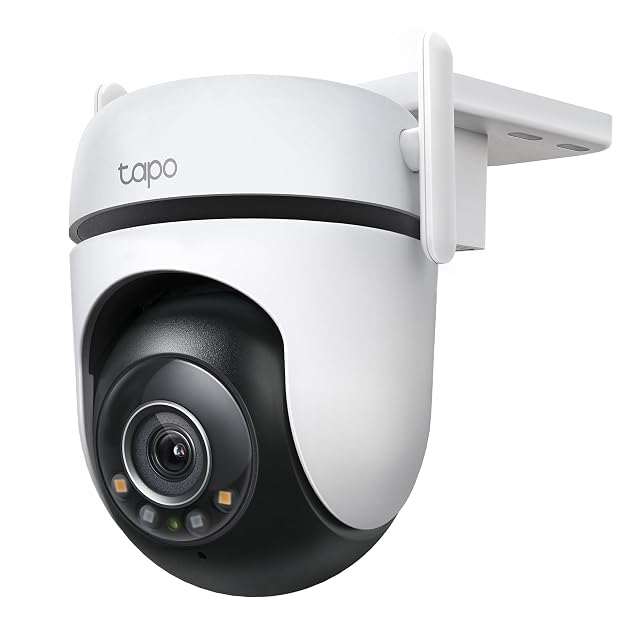
  1. Tapo C520WS

    2K 4MP · F1.6 Starlight · 360° pan · IP66 · Wi-Fi or Ethernet

    A 2560 × 1440 sensor behind an F1.6 lens gives more color in low light before it turns on its spotlights, and it can be wired to Ethernet instead of trusting Wi-Fi.

    Best for: An outdoor position where Wi-Fi is unreliable and a network cable can be run, or where color at night matters more than an unlit image.
    8.1/10

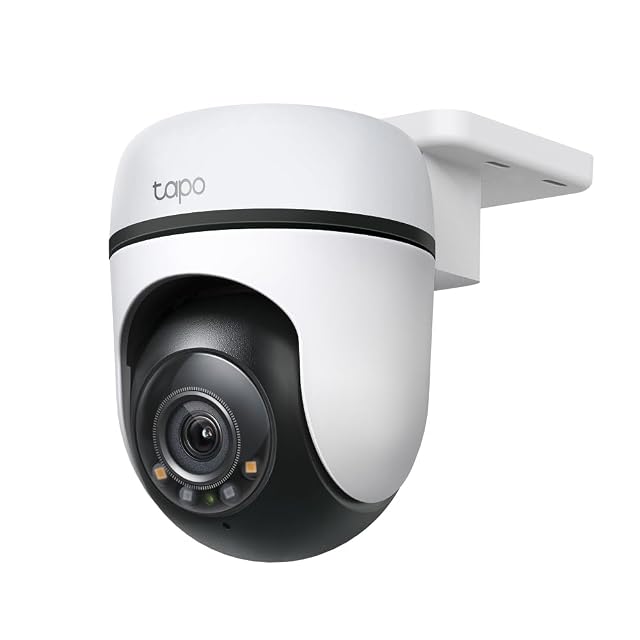
  2. Tapo C51A

    2K · 360° pan, 130° tilt · color night vision to 30 m (98 ft) · IP65 · siren

    An entry-level 2K motorized camera with color night vision. TP-Link states a 360° sweep, person detection with motion tracking, color at night to 30 m (98 ft) and an IP65 housing.

    Best for: A first motorized camera, where the sweep matters more than tracking a subject at distance.

    7.2/10

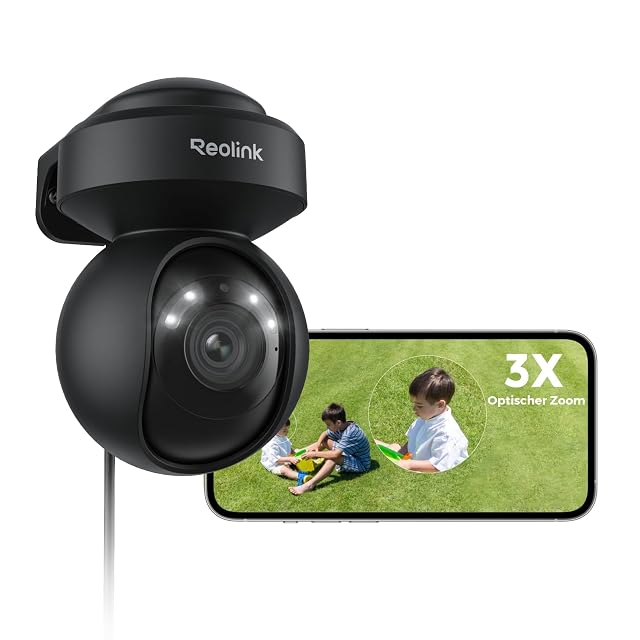
  3. Reolink E1 Outdoor Pro

    4K UHD · 3× optical zoom · dual-band Wi-Fi 6 · 355° pan, 50° tilt · 24/7 recording

    Reolink states 4K with color night images, a genuine three-times optical zoom, dual-band Wi-Fi 6 and auto-tracking across a 355° sweep, with custom detection zones and continuous recording.

    Best for: A property where a face or a license plate at distance actually has to be readable.

    7.8/10

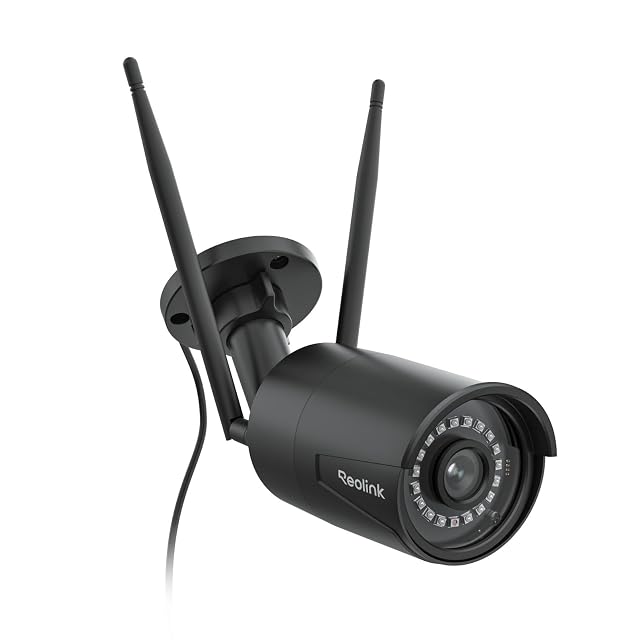
  4. Reolink RLC-510WA-B

    5MP · dual-band 2.4/5 GHz · 30 m (98 ft) IR · microSD to 512 GB, NVR or FTP · IP66

    A fixed 5 MP bullet camera rather than a pan-and-tilt, and the only camera in this hub that will record to an FTP server, as well as to a Reolink NVR or a card. Reolink states dual-band Wi-Fi, person, vehicle and animal detection, and 30 m (98 ft) night vision.

    Best for: Someone who wants a fixed camera pointed at one thing permanently, recorded somewhere other than the camera itself.

    8.1/10

The questions we are asked

What is a Starlight sensor?

A marketing name for a sensor and lens combination tuned for low light — for example a wider aperture, F1.6 instead of F2.2. It produces color in poorer light. It is sensitivity, not night vision: in genuine darkness the camera still uses infrared or its own spotlight.

Color or infrared at night?

Color, if you want to describe somebody to a third party — a coat color is worth more than a shape. Infrared, if you would rather the camera was not noticed. A camera producing color at night is a camera that is lighting the scene, and lit cameras are seen.

Can a camera identify a face at night?

Sometimes, but it depends far more on position and lighting than on the camera. A distant wide view will not, however good the sensor.

Why is my night footage a white haze?

Usually a dirty lens or a cobweb reflecting infrared straight back. Cleaning fixes it, and it looks alarmingly like a hardware fault.

Can I put a camera behind a window?

At night, poorly. Infrared reflects off the glass. Either mount outside, or turn infrared off and light the scene from outside.

Does more infrared range help?

Only up to a point. Lighting the approach usually does more for footage quality than a camera with a longer stated range.

Why do I get so many night alerts?

Insects and spiders are attracted to infrared illuminators and fly close to the lens. Cleaning and adjusting sensitivity is the usual fix.

Each device, and the door it watches

Tapo C520WS

Designed for: An outdoor position where Wi-Fi is unreliable and a network cable can be run, or where color at night matters more than an unlit image.
Its main asset: Ethernet as well as Wi-Fi — the only camera in this hub to state it

Its main gap: Color at night still needs some ambient light — it is a sensitive sensor, not night sight

Read the full review →

Tapo C51A

Designed for: A first motorized camera, where the sweep matters more than tracking a subject at distance.

Its main asset: Color night vision stated to 30 m (98 ft) — a long published distance for an entry-level model

Its main gap: IP65, below the IP66 stated by DEKCO in this hub

Read the full review →

Reolink E1 Outdoor Pro

Designed for: A property where a face or a license plate at distance actually has to be readable.

Its main asset: 3× optical zoom — glass, not pixels, which is the difference that matters

Its main gap: Tilt of 50° is shallower than the 90° or 130° of cheaper cameras

Read the full review →

Reolink RLC-510WA-B

Designed for: Someone who wants a fixed camera pointed at one thing permanently, recorded somewhere other than the camera itself.

Its main asset: 5 MP — the highest resolution in this hub, stated by Reolink

Its main gap: Fixed, not pan-and-tilt — what it sees is decided at installation

Read the full review →

What to add to it

Accessories and spares from the same aisle, at the price we read. Confirm they suit the device you choose before ordering: it turns on the model and the part number, which the listing gives.

The short decision

  • If your main worry is our rating → look at Tapo C520WS

Comparisons that matter here

Device against device, already covered, inside this guide or this aisle.

What this comparison is built on

The devices listed are drawn from the catalog of this site. Specifications are those the maker and the Amazon listing publish; prices are what Keepa recorded on the date shown, and both move. The order follows declared specifications, the balance between stated strengths and stated limits, and price. No device here has been installed or tested by us, and no page claims it was.

Last checked on

Prices quoted in these summaries are dated readings. The live price is shown next to each product.

The tool we use ourselves

Chosen your tool? Now buy it at the right price.

Cameras, alarm kits and safes swing by thirty dollars or more across the year, and the biggest "discounts" often land at prices the same model sold for six weeks earlier. UniverTrack tracks the real price history across retailers, spots fake reductions, and alerts you when it is genuinely the moment to buy.

Real price historyBuy-now alertsAI buying assistant
Try free for 14 days →
No commitment · Cancel in one click · 5 languages