Skip to content

Battery cameras: four that survive the second winter

Battery cameras are bought to escape a cable and abandoned because of a ladder. The specification that decides longevity is rarely the battery: it is whether the pack can be swapped, whether the runtime figure states its assumptions, and whether the Wi-Fi is good enough that the camera is not draining itself trying to connect.

The failure mode of a battery camera is not the battery. It is the ladder.

Swappable beats large

A sealed camera on a gable end must come down to charge. Many owners do that twice and then leave it dead. A quick-release pack, charged indoors and swapped in under a minute, is the only real answer — buy the second pack with the camera.

Read the runtime claim properly

Months, assuming few triggers a day, a number almost no maker publishes. Point the camera across an approach rather than along a sidewalk and the same camera lasts much longer. Placement is the runtime specification.

Wi-Fi is a power question

A camera that struggles to associate wakes repeatedly and drains itself. Dual-band support, or a position with real signal, matters more than an extra megapixel.

What no battery camera does

Capture the approach. They sleep, and the fraction of a second it takes to wake is the fraction somebody walks up. A wired camera has no such gap.

Which device does your home need?

You cannot run power to the spot
A battery camera, which is exactly what the format is for.
You rent
Battery cameras mount with minimal fixing and come off cleanly.
The view is busy
Expect frequent recharging, because every motion event costs battery.
You need continuous recording
Not a battery camera; that is a wired requirement.

Picking by what you are protecting

Places with no power

The core use. Sheds, gates, fences and anywhere a cable would be a project.

Temporary coverage

Where a camera is needed for a period rather than permanently, and where removability matters.

Renting

Where minimal fixing and clean removal decide what is possible at all.

Busy views

Where battery cameras struggle, because constant motion means constant recording.

What actually protects, and what is noise

Battery life in your actual view
Published figures assume modest activity. A camera facing a sidewalk records constantly and drains far faster.
Removable or built-in battery
A removable battery lets you swap a charged one in seconds. A built-in battery means the camera comes down every time.
Solar panel option
In a position with real daylight, a panel can end the charging problem entirely. In a shaded corner it will not.
Detection settings
Sensitivity and zones determine how often the camera wakes. Tuning them is the main way to extend battery life.
Where it will be mounted
A camera you need a ladder to reach is a camera you will resent every recharge.

Which figure for which entrance

Your situationWhat helpsWhy
Busy viewTighter detection zonesEvery event costs battery
Sunny positionA solar panelEnds the charging cycle
High mountingRemovable batteryNo ladder each time
Need everything recordedA wired cameraBattery cannot do it

Where this is usually botched

Pointing it at a busy road
Every passing car is an event. The battery lasts days rather than months, and the notifications become unusable.
Mounting it out of easy reach
Recharging becomes a ladder job, and a chore that awkward gets postponed until the camera is dead.
Expecting the quoted battery life
It assumes light activity. Your actual view decides the real figure, and it is usually much shorter.
Fitting a solar panel in the shade
A panel that never sees direct light does not meaningfully charge anything. Position matters more than the panel.

By the home you have

The renter
Uses battery cameras because nothing else is permitted, and tunes detection to keep the charging manageable.
The owner of an outbuilding
Uses one where cabling would be a project, ideally with a solar panel.
The one with a busy frontage
Will struggle with battery cameras and should consider wiring the important position.

Batteries, updates and working life

Battery cameras are a maintenance commitment, and the maintenance is what people underestimate. Lithium batteries also lose capacity in cold weather, so a camera that lasted all summer can need weekly charging in winter.

  • Recharge before the battery is flat rather than after; deep discharge is hard on cells.
  • Expect shorter life in cold weather; it is normal rather than a fault.
  • Clean the lens and the PIR window; spiders trigger events and drain batteries.
  • Review detection zones periodically as seasons change the view.

Safety

Batteries, height and networks.

  • Do not use damaged or swollen batteries; replace them.
  • Mount safely and use a stable ladder; falls are the real risk here.
  • Change the default password before the camera goes up.
  • Position the camera to cover your own property rather than a neighbor's.

The choices, and what settled them

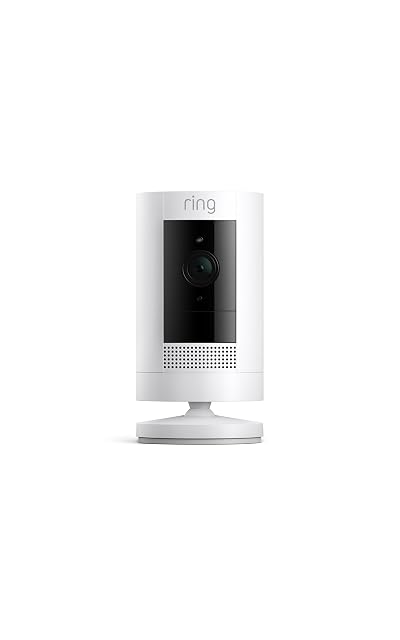
  1. Ring Stick Up Cam Battery

    1080p · 130° diagonal · quick-release battery pack · custom motion zones

    Ring's small battery camera, and the only one in this hub with a battery pack you swap in seconds rather than a camera you take down to charge. 1080p, 130° diagonal field of view, and customizable motion zones.

    Best for: A Ring household, or anyone who wants a spare battery on the shelf instead of a ladder every recharge.

    7.8/10

  2. ieGeek ZS-GX3S

    2K 3MP · battery, 3–6 months stated · PIR detection · siren and light · 2.4 GHz

    ieGeek publishes an unusually specific runtime — three to six months per charge — alongside 2K capture, PIR detection and a siren with a white light. It works indoors or out, and it is 2.4 GHz only.

    Best for: A shed, a side return or a room with no socket, where the camera should be left alone for a season.

    7.8/10

  3. HITELLARCAM CB54W

    2K · battery · 2.4/5 GHz dual band · color night vision · free cloud clips

    A dual-band battery camera at the price most single-band ones sell for. HITELLARCAM states 2K capture, color night vision, AI person detection and free cloud storage for clips alongside a card slot.

    Best for: A first battery camera where the Wi-Fi at the far end of the property is the real problem.

    7.2/10

  4. Tapo C425

    2K QHD · 10,000 mAh · magnetic base · 142° FOV · free AI detection · solar ready

    TP-Link's battery camera: 2K on a 142° lens, a 10,000 mAh cell, a magnetic base that grips any iron surface, and person, pet and vehicle detection included rather than sold as a subscription feature.

    Best for: Someone who wants a battery camera that can be repositioned in seconds and detection that costs nothing extra.

    8.4/10

The questions we are asked

How long do battery cameras really last?

As long as their triggers allow. Every quoted runtime assumes a number of events per day, and a camera facing a sidewalk sees far more than a camera facing a backyard. Where a maker does not publish the assumption, this site does not convert the claim into weeks.

Does a solar panel solve it?

From spring to autumn, effectively. In December at a northern latitude a small panel produces a fraction of its summer output, and that is when the camera is busiest. The panel keeps a battery topped up for nine months; the battery carries the other three.

Can a battery camera record continuously?

No. It records clips around motion to preserve battery, which is the fundamental trade of the format.

Why does mine drain so fast in winter?

Cold reduces lithium battery capacity, and darker scenes mean more infrared use. Both are normal rather than faults.

Should I mount it high?

High enough to be out of easy reach, but not so high that every recharge needs a ladder. That balance is worth thinking about before drilling.

How do I make the battery last longer?

Narrow the detection zones, reduce sensitivity and shorten clip length. Every event you avoid recording is battery saved.

Each device, and the door it watches

Ring Stick Up Cam Battery

Designed for: A Ring household, or anyone who wants a spare battery on the shelf instead of a ladder every recharge.

Its main asset: Quick-release battery pack — charge a spare and swap it in seconds

Its main gap: Video history needs a Ring Home subscription — there is no card slot

Read the full review →

ieGeek ZS-GX3S

Designed for: A shed, a side return or a room with no socket, where the camera should be left alone for a season.

Its main asset: Runtime published as a range — 3 to 6 months — rather than as a vague claim

Its main gap: 2.4 GHz Wi-Fi only

Read the full review →

HITELLARCAM CB54W

Designed for: A first battery camera where the Wi-Fi at the far end of the property is the real problem.

Its main asset: Dual-band 2.4 and 5 GHz — genuinely rare on a battery camera this cheap

Its main gap: Runtime is stated as "months" with no event count behind it

Read the full review →

Tapo C425

Designed for: Someone who wants a battery camera that can be repositioned in seconds and detection that costs nothing extra.

Its main asset: AI person, pet and vehicle detection at no extra cost, stated by TP-Link

Its main gap: A magnetic base is as quick to remove as it is to fit

Read the full review →

What to add to it

Accessories and spares from the same aisle, at the price we read. Confirm they suit the device you choose before ordering: it turns on the model and the part number, which the listing gives.

The short decision

  • If your main worry is our rating → look at Tapo C425

Comparisons that matter here

Device against device, already covered, inside this guide or this aisle.

What this comparison is built on

The devices listed are drawn from the catalog of this site. Specifications are those the maker and the Amazon listing publish; prices are what Keepa recorded on the date shown, and both move. The order follows declared specifications, the balance between stated strengths and stated limits, and price. No device here has been installed or tested by us, and no page claims it was.

Last checked on

Prices quoted in these summaries are dated readings. The live price is shown next to each product.

The tool we use ourselves

Chosen your tool? Now buy it at the right price.

Cameras, alarm kits and safes swing by thirty dollars or more across the year, and the biggest "discounts" often land at prices the same model sold for six weeks earlier. UniverTrack tracks the real price history across retailers, spots fake reductions, and alerts you when it is genuinely the moment to buy.

Real price historyBuy-now alertsAI buying assistant
Try free for 14 days →
No commitment · Cancel in one click · 5 languages